








Physicsstandard
Estimating the Size of the Hydrogen Atom (i.e., Bohr's Radius) using Equipartition
Peering into the hydrogen atom . The standard way to obtain the size of the hydrogen atom, also known as Bohr's radius, is to solve Schrödinger equation for the hydrogen atom. This is a somewhat detailed calculation requiring the usage of generalized Laguerre polynomials and…
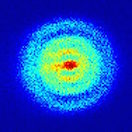
Peering into the hydrogen atom.
The standard way to obtain the size of the hydrogen atom, also known as Bohr’s radius, is to solve Schrödinger equation for the hydrogen atom. This is a somewhat detailed calculation requiring the usage of generalized Laguerre polynomials and spherical harmonics. We can however bypass it, if we are only interested in an estimate of the hydrogen atom.
One method which we don’t follow here, is to estimate the size of the atom using dimensional analysis. Instead, we shall do so using the principle of equipartition.
The potential energy of a single electron is given by:
is Bohr’s radius which we are seeking.
On the other hand, one can place a limit on the kinetic energy using the uncertainty principle. The latter is:
Thus, the typical momentum that the electron will have, will be roughly
The total energy is therefore
The system will seek a minimum energy. So, in principle we can differentiate this expression with respect to to find the minimum. However, this is pointless because the expression itself is not accurate. Instead, we can ask the question when will the two terms be comparable. This is permissible because the terms do not have any typical length scale to them other than , such that . Thus, by comparing the terms we find:
Fools are lucky. It turns out that this expression is not just approximate, but it actually has the correct prefactor. Another interesting point, we can write this expression as:
with being the fine structure constant, while is the Compton wavelength of the electron.
Using this result for , we can calculate the energy associated with Bohr’s radius, which is the Rydberg energy. We do so by plugging in the we have found to either or (note that the two terms were assumed to be the same at !). Plugging into gives
where is the energy of the lowest state (i.e., 1 Rydberg).
We can immediately also find out how the result will change if we consider a high-Z hydrogen like atom (e.g., the radius of Fe ionized 25 times, leaving just one electron), or if we consider a positronum.
In the first case of a high-Z hydrogen like atom, all we have to realize is that here the potential energy has in it instead of . By make this transformation, that , we can therefore deduce that
Similarly, if we consider a positronium (which is a positron-electron pair orbiting each other), all we have to do is remember our classical mechanics. The relevant quantity in a two body problem is not the mass, but instead the reduced mass . For the positron+electron case, one has . Hence, the radius of the lowest orbit of a positronium is obtained by , giving that
Clearly, equipartition can be a very useful tool to derive the approximate properties of atoms, and perhaps more impressively, derive how those properties scale between different systems.