
Physicsstandard
Newton's laws
Newton's laws and other laws of nature cannot be "derived" or "proved" like proofs in Math. Instead, physical laws are conjectured and then studied through experiments. These laws can be verified under different limits, in which case the conjected laws become accepted theory, or…
Newton’s laws and other laws of nature cannot be “derived” or “proved” like proofs in Math. Instead, physical laws are conjectured and then studied through experiments. These laws can be verified under different limits, in which case the conjected laws become accepted theory, or they can be falsified in the experiments, in which case the conjectured can be trashed.
For example, during the time of Aristotle, it was commonly thought that the free fall speed of an object is proportional to its weight, namely, heavier objects fall faster. Another misconception was the Aristotlian idea that in the absence of any external motive power, all objects (on Earth) would naturally come to rest, to a state of no motion. These ideas and others would have been easily falsified if the Greeks and their later followers would have realized that natural laws should be experimentally verified. For us, this concept is almost trivial, but it was only Francis Bacon in the 16th century who solidified this idea.
Newton derived his laws following his analysis of different experiments and observations, but later his laws were verified time and again in many different experimental setups. It is only once we leave the realm of classical mechanics that we have to modify Newton’s laws. Special Relativity is required for very high speeds while very small scales requires quantum mechanics.
Newton's First law of Motion: Law of Inertia
The first law, which is called the law of intertia, was to some extent first formulated by Galileo, who realized that:
Newton later reformulated as a somewhat more general conjecture:
In other words, an object at rest will stay at rest, while an object in motion will tend to stay in motion in a straight line while keeping a constant velocity, unless acted upon by an external force.
Newton's Second law of Motion: Law of Motion
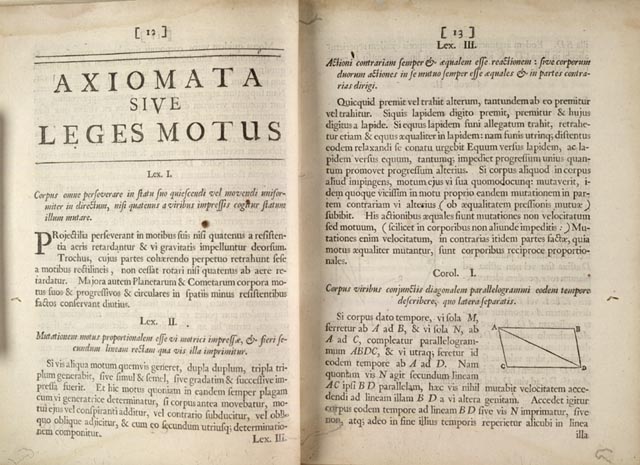
Loosly translated from latin, Newton’s second law of motion states that:
That is, Newton’s original formulation of his second law in current day notation is
Newton knew also very well that the change of motion is large for smaller masses, namely, that
Newton did not use the concept of momentum, which was developed only later by Leibniz (the “quantité d’avancement”). For Newton, mass was constant, so the derivative of v or the derivative of p=mv, could not make a big difference anyway. However, once mass is allowed to vary (such as a rocket, or in the theory of relativity), the correct form of the law is in fact that the force is proportional to the rate of change of the momentum:
What about the factor in the proportionality? Well, it turns out that we are free to choose whichever factor we wish! This is because we haven’t stated with which units we measure the force! In fact, we choose the proportionality constant to be unity and with that define the units of force. Thus, in SI, the unit of force called Newton is defined as kg m s-2. In c.g.s, the unit is: dyne = gr cm s-2.
Newton's Third law of Motion: Law of Action and Reaction
Newton’s third law states that
To every force applied there is an equal but opposite force applied (i.e., in the opposite direction). In other words, if object A exerts a force on object B, object B will exert the same magnitude force on A, but in the opposite direction.
Example 1:Change of units
Q: What is the relation between the SI and c.g.s units Newton and dyne?
A: Let us divide the definitions:
Hence, Newton = 105dyne.
Example 2: Pushing a cart
Q: If I push a cart, and it pushes me just the same, how come the cart moves and I don’t?
A: Indeed, following the third law of motion, I push the cart just as much as it pushes me. However, my acceleration is determined by the sum of all forces acting on on me, which includes the frictional force that the floor exerts on me. Since it balances the force that the cart exerts on me, I don’t move.
The cart, on the other hand, does not feel any additional force besides the one that I exert on it. Hence, its second law of motion would imlply that it should accelerate.
The uber-geeks would realize that the floor (and hence Earth) feels a force opposite the one that I exert on the cart, hence, Earth should be accelerating too. And indeed it is, however, because its mass is VERY much larger than that of the cart, this motion is not noticable.