


Notesstandard
Water Propelled Rocket
Water Rockets are simple homemade invensions that model their chemically fueled cousins. Unlike the latter, water rockets operate using water propulsion and hand-pump generated air pressure. Here we describe the equations of the problem. They are also solved numerically in the…
The homemade water rocket is a simple invention. It resembles its chemically fueled cousin in many ways. Unlike the latter, however, the water powered rocket operates using water propulsion and hand-pump generated air pressure.
Here we derive and describe the equations of the problem. If you wish to skip the equations (why would you?), then you can jump ahead to the water rocket simulator, where they are solved numerically and even graphed.
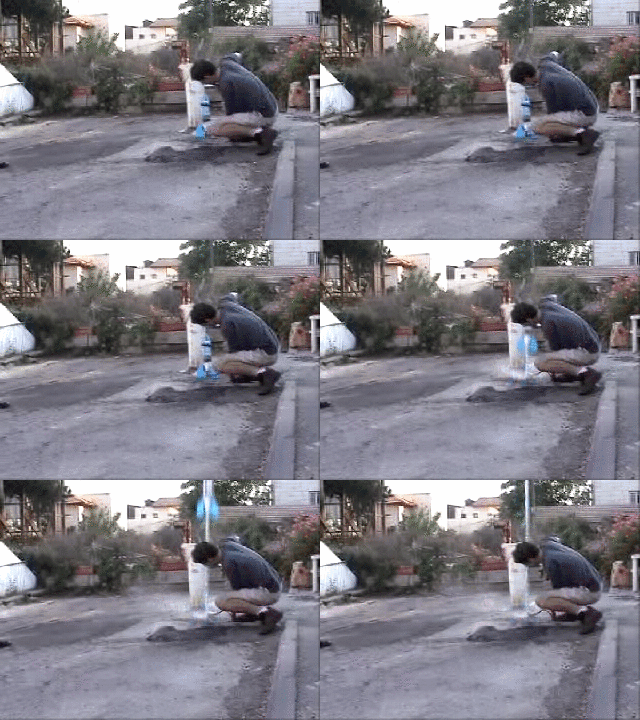
Water rocket demonstration by the author.
We begin with the derivation of the basic rocket equation, using of course conservation of momentum. We then add the external forces, and later continue with calculating the velocity of the ejected water. This is achieved by considering the adiabatic expansion of the gas trapped in the bottle, and the work it does to accelerate the ‘exhaust’.
Mind you, you don’t have to be a rocket scientist to follow the derivation, through you do need first year university physics for it.
The Rocket Equation
Let us begin with no external forces. Newton’s second law basically states conservation of momentum:
Here is the total momentum of the system (i.e., rocket plus water) and is the sum of all the forces acting on the rocket+water system, which is zero without gravity, friction and other forces (and there are!).
We can separate to the momentum of the water which has left the rocket and the momentum of the rocket including the water still left in it: . Written differently, it is:
that is to say, the momentum lost by the rocket is the momentum gained by the water.
On one hand, the momentum of the rocket is:
where is the initial weight of the rocket + water system. If we differentiate, we obtain:
On the other hand, the momentum lost to the water, i.e., the increase in momentum of the water as a function of time is given by the momentum carried by the water
The minus is because the momentum of the water increases, as the mass of the rocket decreases. The velocity of the water leaving the nozzle is relative to the rocket (the “exhaust”), but we calculate the momenta relative to an observer at rest. Thus, water leaving the rocket, leaves at a velocity of relative to the ground.
All in all, we get:
The terms cancels out, and we obtain
where we defined as the rate of mass loss (the minus is so that will be positive, since the rocket loses mass with time).
If we look at the mass and velocity change over an interval , this equation reads
If we integrate from an initial velocity , we find
This equation is called Tsiolkovsky’s equation after the guy who derived it in 1903. We see that in order to get large velocity changes, relative to the exhaust velocity, large change in the mass are required. For example, typical exhaust velocities obtained through chemical reactions are 3-4.5 km/s. However, to accelerate a rocket out of Earth’s orbit, we need 11.2 km/s. This implies that the initial mass of the rocket needs to be about 25 times larger than the payload! (Ever seen a Saturn V Rocket which sent the Apollos? Another option is to use much faster exhaust, such as in “ion thrusters”, but they use more energy…).
Adding external forces
What happens if we have additional forces? If external forces act on the rocket, then they will too contribute to a change in the momentum:The main forces which the rocket feels is the gravitational force, equal to (i.e., pointing in the negative direction of ). The second force is that of drag. Stokes drag is valid only at small velocities. At higher velocities, where turbulence arises, the drag force is generally written as , where is the cross-section of the object and is the drag coefficient. The latter number is dimensionless and it is expected to be of order unity. In case of a smoothed cylinder it is . Cars can have . A sphere typically has . The number depends on the geometry and the velocity. The ½ in the definition is just a standard convention.
In scalar form, when the motion is in 1D, we can write Thus, the equations we need to solve are
or
according to whether water is flowing out or not.
Note that the exhaust speed through the nozzle can vary with time. This is because it depends on the pressure of the air above the water, and the pressure decreases as the air compartment volume increases. Thus, we need more physical modeling to obtain .
Adiabatic Expansion of the Gas
Since the velocity of the receding water level moves slower than the speed of sound, we can assume that the expansion of the compressed air is quasi-static. Moreover, it is faster than the time it takes the air to thermally equilibrate with the surrounding. We can therefore assume that the expansion of the gas is adiabatic. The relation between the pressure and the density is therefore given by the adiabatic law:where is the adiabatic index. For air it is . Thus, the relation between the volume of the trapped air and the pressure is given by:
Thus, as the water leaves the bottle, the weight decreases, the air volume increases and the pressure decreases as well.
The nozzle velocity and thrust
The last link we require is between the internal air pressure and the nozzle speed. In principle, the pressure difference between the internal air and the external air does work which accelerates the bulk of the water (which begins at rest) and also the water to the exhaust speed. A full analysis reveals that the system quickly reaches an equilibrium where the work done by the expanding air is used solely to accelerate water out of the nozzle. That is, the inertia of the water within the bottle can be neglected (unless the nozzle is not much smaller than the bottle’s radius).
From thermodynamics, we know that the work done by the gas is where is the pressure difference between the internal and external air and is the volume change. Using the above, the rate work is done by the trapped air is equal to the energy required to accelerate the water out of the nozzle. We find,
We also have a relation between the change in air volume and the rate of mass loss: . Hence,
The mass-loss rate through the nozzle (with radius ) can be related to the nozzle velocity:
This is the last relation we need to close our set of equations.
Summary of equations solved
If you got lost along the way, here is a summary of the equations solved.
At every given moment, we can calculate the internal pressure , the mass loss rate and the thrust given the current mass of the rocket :
Given the thrust and the mass loss rate, we can integrate the equations of motion and an equation for the evolution of the internal mass:
If the rocket has emptied itself, and weighs only , we are left we simple ballistic (+drag) equations:
These equations are solved for in the water rocket simulator.
Interestingly, it is easy to see that the condition required for liftoff. We need the thrust to be larger than the gravitational full. Thus,
If the initial mass is too high, liftoff will commence only after enough mass has left the bottle to satisfy this equation.