
Water Propelled Rocket
The homemade water rocket is a simple invention. It resembles its chemically fueled cousin in many ways. Unlike the latter, however, the water powered rocket operates using water propulsion and hand-pump generated air pressure.
Here we derive and describe the equations of the problem. If you wish to skip the equations (why would you?), then you can jump ahead to the water rocket simulator, where they are solved numerically and even graphed.
 We begin with the derivation of the basic rocket equation, using of course conservation of momentum. We then add the external forces, and later continue with calculating the velocity of the ejected water. This is achieved by considering the adiabatic expansion of the gas trapped in the bottle, and the work it does to accelerate the 'exhaust'.
Mind you, you don't have to be a rocket scientist to follow the derivation, through you do need first year university physics for it.
We can separate $P$ to the momentum $P_w$ of the water which has left the rocket and the momentum $P_r$ of the rocket including the water still left in it: ${d P_r / dt } + {d P_w/ dt } = 0$. Written differently, it is: $$ \displaystyle {d P_r \over dt } = - {d P_w \over dt }, $$ that is to say, the momentum lost by the rocket is the momentum gained by the water.
On one hand, the momentum of the rocket is: $$P_r = M(r) v(t) ,$$ where $M_0$ is the initial weight of the rocket + water system. If we differentiate, we obtain: $${d P_r \over d t} = {d M \over dt} v + M {dv \over dt} .$$ On the other hand, the momentum lost to the water, i.e., the increase in momentum of the water as a function of time is given by the momentum carried by the water $${d P_w \over d t} = \left(-{d M \over dt}\right) (v-V_e).$$ The minus is because the momentum of the water increases, as the mass of the rocket decreases. The velocity of the water leaving the nozzle is $-V_e$ relative to the rocket (the "exhaust"), but we calculate the momenta relative to an observer at rest. Thus, water leaving the rocket, leaves at a velocity of $v-V_e$ relative to the ground.
All in all, we get: $${d M \over dt} v + M {dv \over dt} = \left({d M \over dt}\right) (v-V_e) .$$ The $({d M / dt}) v$ terms cancels out, and we obtain $$M {dv \over dt} = (-{d M \over dt}) V_e = \alpha V_e ,$$ where we defined $\alpha \equiv -(dM / dt)$ as the rate of mass loss (the minus is so that $\alpha$ will be positive, since the rocket loses mass with time).
If we look at the mass and velocity change over an interval $d t$, this equation reads $$dv = - V_e { d M \over M} .$$ If we integrate from an initial velocity $v_0$, we find $$v-v_0 = V_e \ln {M_0 \over M}.$$ This equation is called Tsiolkovsky's equation after the guy who derived it in 1903. We see that in order to get large velocity changes, relative to the exhaust velocity, large change in the mass are required. For example, typical exhaust velocities obtained through chemical reactions are 3-4.5 km/s. However, to accelerate a rocket out of Earth's orbit, we need 11.2 km/s. This implies that the initial mass of the rocket needs to be about 25 times larger than the payload! (Ever seen a Saturn V Rocket which sent the Apollos? Another option is to use much faster exhaust, such as in "ion thrusters", but they use more energy...).
In scalar form, when the motion is in 1D, we can write $F_d = -{1\over 2} C_d \rho_{air} A v \left| v\right| \equiv \beta v \left| v\right|.$ Thus, the equations we need to solve are $$ M {d v_z \over dt} = \alpha V_e - g M - \beta v_z \left| v_z \right|, \mathrm{~(with~water)},$$ or $$ M_0 {d v_z \over dt} = - M_0 g - \beta v_z \left| v_z \right|, \mathrm{~(without~water)}, $$ according to whether water is flowing out or not.
Note that the exhaust speed through the nozzle can vary with time. This is because it depends on the pressure of the air above the water, and the pressure decreases as the air compartment volume increases. Thus, we need more physical modeling to obtain $V_e$.
From thermodynamics, we know that the work done by the gas is $dW = \Delta p dV$ where $\Delta p=(p_{in}-p_{out})$ is the pressure difference between the internal and external air and $dV$ is the volume change. Using the above, the rate work is done by the trapped air is equal to the energy required to accelerate the water out of the nozzle. We find, $$ {dW \over dt} = \Delta p {d V \over dt} = {1\over 2}{dM \over dt} V_e^2 .$$ We also have a relation between the change in air volume and the rate of mass loss: $ -(dM/dt) = \rho_w (dV/dt)$. Hence, $$ V_e = \sqrt{2 (p_{in}-p_{out}) \over \rho_w} .$$ The mass-loss rate through the nozzle (with radius $r_n$) can be related to the nozzle velocity: $$ -{dM \over dt} = \pi r_n^2 \rho_w V_e .$$ This is the last relation we need to close our set of equations.
At every given moment, we can calculate the internal pressure $P$, the mass loss rate $\alpha$ and the thrust $F_\alpha$ given the current mass of the rocket $M(t)$: $$ p_{in} = p_0 \left(V_0+(M(0)-M(t))/\rho_w\over V_0\right)^{-\gamma}, $$ $$ \alpha \equiv -{dM \over dt} ~=~ \pi r_n^2 \rho_w \sqrt{2 (p_{in}-p_{out}) \over \rho_w}, $$ $$ F_\alpha \equiv -{dm \over dt} V_e ~=~ 2 \pi r_n^2 (p_{in}-p_{out}). $$ Given the thrust and the mass loss rate, we can integrate the equations of motion and an equation for the evolution of the internal mass: $$ {d v_z \over dt} = {F_\alpha\over M} - g - {\beta \over M} v_z \left| v_z \right|, $$ $$ {dz\over dt} = v $$ $$ {dM \over dt} = -\alpha. $$ If the rocket has emptied itself, and weighs only $M_0$, we are left we simple ballistic (+drag) equations: $$ {d v_z \over dt} = - g - {\beta \over M_0} v_z \left| v_z \right|, $$ $$ {dz\over dt} = v. $$ These equations are solved for in the water rocket simulator.
Interestingly, it is easy to see that the condition required for liftoff. We need the thrust to be larger than the gravitational full. Thus, $$ F_\alpha > F_g ~~\Rightarrow ~~ 2 \pi r_n^2 (p_{in}-p_{out}) > M g .$$ If the initial mass is too high, liftoff will commence only after enough mass has left the bottle to satisfy this equation.
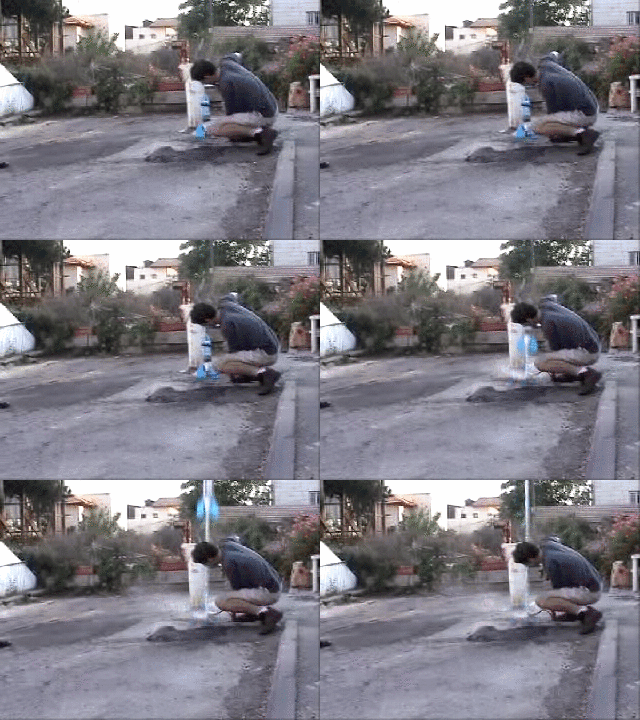
Water rocket demonstration by the author.
Mind you, you don't have to be a rocket scientist to follow the derivation, through you do need first year university physics for it.
The Rocket Equation
Let us begin with no external forces. Newton's second law basically states conservation of momentum: $$ {d P \over dt } = F_{ext} = 0 .$$ Here $P$ is the total momentum of the system (i.e., rocket plus water) and $F_{ex}$ is the sum of all the forces acting on the rocket+water system, which is zero without gravity, friction and other forces (and there are!).We can separate $P$ to the momentum $P_w$ of the water which has left the rocket and the momentum $P_r$ of the rocket including the water still left in it: ${d P_r / dt } + {d P_w/ dt } = 0$. Written differently, it is: $$ \displaystyle {d P_r \over dt } = - {d P_w \over dt }, $$ that is to say, the momentum lost by the rocket is the momentum gained by the water.
On one hand, the momentum of the rocket is: $$P_r = M(r) v(t) ,$$ where $M_0$ is the initial weight of the rocket + water system. If we differentiate, we obtain: $${d P_r \over d t} = {d M \over dt} v + M {dv \over dt} .$$ On the other hand, the momentum lost to the water, i.e., the increase in momentum of the water as a function of time is given by the momentum carried by the water $${d P_w \over d t} = \left(-{d M \over dt}\right) (v-V_e).$$ The minus is because the momentum of the water increases, as the mass of the rocket decreases. The velocity of the water leaving the nozzle is $-V_e$ relative to the rocket (the "exhaust"), but we calculate the momenta relative to an observer at rest. Thus, water leaving the rocket, leaves at a velocity of $v-V_e$ relative to the ground.
All in all, we get: $${d M \over dt} v + M {dv \over dt} = \left({d M \over dt}\right) (v-V_e) .$$ The $({d M / dt}) v$ terms cancels out, and we obtain $$M {dv \over dt} = (-{d M \over dt}) V_e = \alpha V_e ,$$ where we defined $\alpha \equiv -(dM / dt)$ as the rate of mass loss (the minus is so that $\alpha$ will be positive, since the rocket loses mass with time).
If we look at the mass and velocity change over an interval $d t$, this equation reads $$dv = - V_e { d M \over M} .$$ If we integrate from an initial velocity $v_0$, we find $$v-v_0 = V_e \ln {M_0 \over M}.$$ This equation is called Tsiolkovsky's equation after the guy who derived it in 1903. We see that in order to get large velocity changes, relative to the exhaust velocity, large change in the mass are required. For example, typical exhaust velocities obtained through chemical reactions are 3-4.5 km/s. However, to accelerate a rocket out of Earth's orbit, we need 11.2 km/s. This implies that the initial mass of the rocket needs to be about 25 times larger than the payload! (Ever seen a Saturn V Rocket which sent the Apollos? Another option is to use much faster exhaust, such as in "ion thrusters", but they use more energy...).
Adding external forces
What happens if we have additional forces? If external forces act on the rocket, then they will too contribute to a change in the momentum: $$ M {dv \over dt} = \alpha V_e + F_{ext} = \alpha V_e + F_{grav} + F_{drag} .$$ The main forces which the rocket feels is the gravitational force, equal to $F_{grav} = -M g$ (i.e., pointing in the negative direction of $z$). The second force is that of drag. Stokes drag $F_d \propto - v$ is valid only at small velocities. At higher velocities, where turbulence arises, the drag force is generally written as ${\bf F}_d = -{1\over 2} C_d \rho_{air} A v^2 {\bf \hat v}$, where $A$ is the cross-section of the object and $C_d$ is the drag coefficient. The latter number is dimensionless and it is expected to be of order unity. In case of a smoothed cylinder it is $C_d \sim 1$. Cars can have $C_d \sim 0.2 - 0.5$. A sphere typically has $C_d \sim 0.5$. The number depends on the geometry and the velocity. The ½ in the definition is just a standard convention.In scalar form, when the motion is in 1D, we can write $F_d = -{1\over 2} C_d \rho_{air} A v \left| v\right| \equiv \beta v \left| v\right|.$ Thus, the equations we need to solve are $$ M {d v_z \over dt} = \alpha V_e - g M - \beta v_z \left| v_z \right|, \mathrm{~(with~water)},$$ or $$ M_0 {d v_z \over dt} = - M_0 g - \beta v_z \left| v_z \right|, \mathrm{~(without~water)}, $$ according to whether water is flowing out or not.
Note that the exhaust speed through the nozzle can vary with time. This is because it depends on the pressure of the air above the water, and the pressure decreases as the air compartment volume increases. Thus, we need more physical modeling to obtain $V_e$.
Adiabatic Expansion of the Gas
Since the velocity of the receding water level moves slower than the speed of sound, we can assume that the expansion of the compressed air is quasi-static. Moreover, it is faster than the time it takes the air to thermally equilibrate with the surrounding. We can therefore assume that the expansion of the gas is adiabatic. The relation between the pressure and the density is therefore given by the adiabatic law: $$ p_{in} \propto \rho^{\gamma} ,$$ where $\gamma$ is the adiabatic index. For air it is $\gamma \approx 1.4 $. Thus, the relation between the volume of the trapped air and the pressure is given by: $$ p_{in} = p_0 \left(V\over V_0\right)^{-\gamma} = p_0\left(V_0+(M(0)-M(t))/\rho_w\over V_0\right)^{-\gamma}.$$ Thus, as the water leaves the bottle, the weight $M(t)$ decreases, the air volume increases and the pressure decreases as well.The nozzle velocity and thrust
The last link we require is between the internal air pressure and the nozzle speed. In principle, the pressure difference between the internal air and the external air does work which accelerates the bulk of the water (which begins at rest) and also the water to the exhaust speed. A full analysis reveals that the system quickly reaches an equilibrium where the work done by the expanding air is used solely to accelerate water out of the nozzle. That is, the inertia of the water within the bottle can be neglected (unless the nozzle is not much smaller than the bottle's radius).From thermodynamics, we know that the work done by the gas is $dW = \Delta p dV$ where $\Delta p=(p_{in}-p_{out})$ is the pressure difference between the internal and external air and $dV$ is the volume change. Using the above, the rate work is done by the trapped air is equal to the energy required to accelerate the water out of the nozzle. We find, $$ {dW \over dt} = \Delta p {d V \over dt} = {1\over 2}{dM \over dt} V_e^2 .$$ We also have a relation between the change in air volume and the rate of mass loss: $ -(dM/dt) = \rho_w (dV/dt)$. Hence, $$ V_e = \sqrt{2 (p_{in}-p_{out}) \over \rho_w} .$$ The mass-loss rate through the nozzle (with radius $r_n$) can be related to the nozzle velocity: $$ -{dM \over dt} = \pi r_n^2 \rho_w V_e .$$ This is the last relation we need to close our set of equations.
Summary of equations solved
If you got lost along the way, here is a summary of the equations solved.At every given moment, we can calculate the internal pressure $P$, the mass loss rate $\alpha$ and the thrust $F_\alpha$ given the current mass of the rocket $M(t)$: $$ p_{in} = p_0 \left(V_0+(M(0)-M(t))/\rho_w\over V_0\right)^{-\gamma}, $$ $$ \alpha \equiv -{dM \over dt} ~=~ \pi r_n^2 \rho_w \sqrt{2 (p_{in}-p_{out}) \over \rho_w}, $$ $$ F_\alpha \equiv -{dm \over dt} V_e ~=~ 2 \pi r_n^2 (p_{in}-p_{out}). $$ Given the thrust and the mass loss rate, we can integrate the equations of motion and an equation for the evolution of the internal mass: $$ {d v_z \over dt} = {F_\alpha\over M} - g - {\beta \over M} v_z \left| v_z \right|, $$ $$ {dz\over dt} = v $$ $$ {dM \over dt} = -\alpha. $$ If the rocket has emptied itself, and weighs only $M_0$, we are left we simple ballistic (+drag) equations: $$ {d v_z \over dt} = - g - {\beta \over M_0} v_z \left| v_z \right|, $$ $$ {dz\over dt} = v. $$ These equations are solved for in the water rocket simulator.
Interestingly, it is easy to see that the condition required for liftoff. We need the thrust to be larger than the gravitational full. Thus, $$ F_\alpha > F_g ~~\Rightarrow ~~ 2 \pi r_n^2 (p_{in}-p_{out}) > M g .$$ If the initial mass is too high, liftoff will commence only after enough mass has left the bottle to satisfy this equation.
Comments (34)
I mean to cause no offense as I have found this page extremely useful in my study of this topic and am greatful for the obvious effort that has been put into it. However during my study of the equations you have developed I have noticed there is a slight mistake in the first equation of the third to last section of equations. You have divided both sides of the equation by M in order to obtain an expression for dvz/dt. Although mg has been reduced to g and the drag expression has been divided by M the Falpha is missing the division.
N.J.S: Thanks for noting! Indeed it is (well, was) a typo.
Why do NASA operate with a LO Trust witch is half of what your equation gives? It seems like they use pi*r^2*deltaP > Mg to check if the rocket will lift or not...
http://exploration.grc.nasa.gov/education/rocket/rktsim.html
First, just the pressure difference between the bottle and the outside doesn't give a thrust. This is because there is a pressure difference between the inside and outside in every direction. This will average out. (A closed can of soda doesn't fly in some random direction even though the pressure in it is higher than the surrounding, because the average force due to the pressure difference averages out).
The origin of the thrust is not the pressure difference, but the "throwing away" of momentum = mass*velocity. If the area of the nozzle is A, and the velocity of the gas is ve, the thrust will be $F_{thr} = \dot{m} v_e = \rho_w A v_e^2$. Thus, it all boils down to the value of the exhaust velocity.
The velocity is obtained through conversation of energy: The pdV work of the air on the water is transformed into kinetic energy. Since the rate of kinetic energy which has to be supplied is $(1/2)\dot{m}V_e^2$ (with an emphasis on the half!), while the rate of work done by the gas is $$ {dW\over dt} = \Delta p {dV \over dt\right} = \Delta p {\dot{m} \over \rho_w}, $$ one immediately finds $V_e^2 = 2 \Delta p/\rho_w$. When plugged into the thrust, we get $F_{thr} = 2 A \Delta p$.
As a sanity check, you can compare this result to the that of the de Laval nozzle. If we take the limit of an adiabatic index [[\gamma \rightarrow \infty]] (denoted by k in the linked page) then we recover the incompressible fluid case. It gives,
I am going thru your equations to understand why it appears that the rocket will not take off if there is no water but just compressed air. Also if the rocket runs out of water acceleration appears to stop. There is more potential energy available if there is less water and more compressed air. Where does this energy go if it is not accelerating water? I would think it would result in a very high velocity/low mass air stream which would launch the rocket even higher.
Thanks for any insight
The air stream would have high velocity, but very low mass. Hence it would have very little momentum, so that the rocket would also gain very little momentum from the air stream.
according to a simulator I downloaded, the "airboost" as it call it, is actually pretty strong for light rockets from soda bottles. the simulator also optimize the air/water ratio depending on presssure, volume, weight... and mostly ends up beetween 20-30% water.
google:waterrocketsimulator
also, great page! you are the only one to actually put up all equations so that we regular-minded people can use them. I'm building a hot water rocket for school project out of an old fire-extuingisher which will be *powered* both by pressurized air( aprox 15 bar)and heat: I heat it to far beyond boiling point( hopefully I will reach 230 degrees celsius) and then using a de laval nozzle the water boils instantaniously when escaping the pressure and gives much more force. no regular waterrocket simulators can calculate that kind of stuff so I'm really happy to find these equations so I can at least do it myself.
From a pure energy point of view just using air should indeed allow the rocket to go even higher, because you have more compressed air and thus more stored energy. So in practice it must be that the kinetic energy of the escaping air is not transferred to the rocket. Certainly the outlet ("jets") play an important role here, as the size of the exit hole for a given rocket effects the height reached, without changing the amount of energy stored.
My class recently done a water rocket project. Now we have to do a report and i need to calculate the maximum height of our rocket with the use of a inclinometer. At lanch day the angle was 60 and the distance from the person and tyhe lanching pad was 20m. also the height of the person measuring is 5'5.
so can u help and i would like a reply back at the end of today-05/21/07
It's simple trigonometry.
tan 60°=(h-hp)/d, d=20m, hp=5'5=1.65m
h=d tan 60°+hp=1.73*20m+1.65m=36m
The point which surprises me is that I thought a person who is 5'5 should know basic trigonometry. But then again, the US high school system is not know to be the best. (I know from experience).
Cheers,
-- Nir
Dear shaviv (Nir),
It seems that you were unnecessarily rude, particularly since you have no knowledge of the person to whom you so rudely replied. Are they a tall 5th grader? Are they a gifted writer with math struggles? Are they a nice person who deserves kindness? Please don't become a teacher. The last thing our struggling US education system needs is a haughty, condescending, high-minded math whiz for a HS teacher. Or, maybe you were just caught on a bad day... I'm willing to give you the benefit of the doubt.
This is the way I am. People who know me personally know that usually very patient (otherwise I wouldn't have answered this question to begin with!). If anyone was offended, it was by mistake. sorry
I'm 5'10 and don't know trigonometry. But then, I'm only a freshman (high school, not college).
You guys forgot this equation" d=0.5 gt2 "( the 2 is supposed to be to the second power)...do you think you can put it and explain what it means or for what is it?
This is the result you obtain if you integrate the equations for the acceleration twice.
dv/dt = - g
v = -gt + v0
d = -(1/2) gt^2 +v0 t + d0
Hello,
Your simulator works good. I compared the results with my graphic analysis by video and I found the same results :)
I would like to know how you succeed in making your simulator with the last equations? For example, in your p(in) equation you have to know the mass variation...and it is not provided???
Thank you very much. Excuse for my bad English:I'm french...
Ps: Here is the link of my water rocket website(English translations) http://aetmrocket.blogspot.com/
a) I am happy to learn that the equations fit reality ;-)
b) You have nice long rockets on your site. I suppose i'll build one with my son at some point.
c) All the equations are written in the last section. M(t) for example is integrated for with dM/dt = - alpha, where alpha is given by the expression a few lines further up.
-- Nir
can you use a different propellant in replacement of water such as soda?
I believe that soda could be used as well, most parts of the equation should remain the same. Nevertheless, someone used soda for the experiment they should also factor in the air bubble concentration in the soda itself. The way I see it it might just change the whole pressure thing alot. Interesting experiment. i really like the little video as well.
I am just extatic with the idea that someone mathed the water powered rocket idea out! Nice,
I understand that, if you make your launcher with a pipe that fits snugly within the nozzle of the rocket, then the rocket has a little travel and initial velocity before the water starts to burst forth after clearing the top of the pipe. (Also adds a little stability to the launch, because the fins are ineffective until air is moving past them.)
How could this be incorporated into your equations?
Do you agree that one of the differences of most significance is that the rocket is pushing against the mass of the whole earth that initial nanosecond, as opposed to just pushing against the mass of the escaping water?
I didn't check your equations but they look much beeter than the simulation I tried to do using an Excel spreadsheet and numerical calculations. I'm happy that my aproach of starting with the Momentum Balance was correct. I just didn't go so deep in considering all involved forces. Congratulations!!
I'm trying to use the water rocket simulator and I'm receiveing a message of "Page not Found" after I introduce the date and click to start. Before I start to check my internet connections and provider, I would like to know if there is any issue with the simulator or with the site.
Thanks in advance
Cid Miró Neto, from Brazil
you have written a minus sign in front of the gamma constant 1.4 at the part about the nozzle velocity and thrust, i've checked with wikipedia since I couldn't make any sense of it and there i found the same formula but without the minus so I take it that you put it there by mistake. i've followed your whole rocket equation and it has helped me a lot, since I thought it was the area*pressure in the nozzle that would create the force upwards. now i'm just stuck at deriving the M(t) formula that one should be able to get out of the equations. the simulator doesn't work for me :(
Hello,
I'd like to first thank you for a magnificent job you've done in writing down and explaining all these equations, they've really helped me a lot in modelling my own water-powered rocket. However, I couldn't help but notice a slight slip-up on your part. Take a look at the equation in which you define bèta. In it, you define bèta to be -(1/2)*A*Cd*rho. In the next equation describing the change in the vertical speed, you then subtract Ff, which was already defined as negative, effectively adding the friction force to the accelaration.
It wasn't hard to notice the slip-up when I was implementing it into my model, but I thought I'd notify you to prevent people from making errors in the future.
Yor rocket is cool !!! Your equations are way over my head!!! Would it be possible to explain what happens to the weight of a space ship as it leaves earth and gravitational pull becomes less, in a simple way i can explain to an elevn year old!!! I know that its weight will reduce as gravity becomes less, but it also looses mass ( as it uses up fuel). Is there a very very simple way of explaining this without a lot of equations, thanks
i know this has been more focused on physics but you have a typo in the sentence, "Mind you, you don't have to be a rocket scientist to follow the derivation, through you do need first year university physics for it." It should be "though" not "through." One year of university schooling should be more than enough for that one. :)
Is there some way that the thrust produced by one of these rockets can be described as a function of time?
Ive been trying solving these equations in Office excel, bit it doesnt work. How is m(t) being calculated out of mass rate a?
And what are the units for:
- p0
- V0
- m(0)
- m(t)
- pw
- r
thanks
I work in the platinum mines of south Africa. I an currently trying to solve the problem of calculating the number of persons that it needs to handle a compressed air/water device that could be used to move broken ore (basically a cannon). The compressed air is at 5 bar and is typically fed through a 50 mm flexible hose. after the air is released by the dead-mans valve water will be added via a 25 mm hose. Will I have to reduce the nozzle diameter in order to keep the device managable? Currently the air is used alone, which is noisy and not too effective, ussually the hose needs three people to keep it under control. I am sure the added water mass will improve the effectivness.
I could go the trial and error route but after seeing this web site I am sure it can be calculated to an acceotable degree.
Hi,
and congratulations for this nice page. I'd like to point out, however, that the physics of water rockets is not quite as simple as you put it.
In particular, when predicting the water ejection you have to take account of the fact that the rocket is accelerated upwards. The apparent gravity in the rocket can be as large as 100 g's which is not negligible compared to the pressure.
You may also have noticed the fog in the rocket at the end of a launch. This comes from water condensation during the adiabatic expansion of the air. Condensation being exothermic, it contributes positively to the thrust.
If you are interested, I wrote a paper on that topic in American Journal of Physics; you can ask for a copy of it on
http://orbi.ulg.ac.be/handle/2268/36471.
Cheers,
Hi,
I'd be interested to know how this calculator was coded. What language have you written this in? Is it a runge-kutta? Is there any way you could share this?
Cheers
Pages