
Standing on ice - When is it possible?
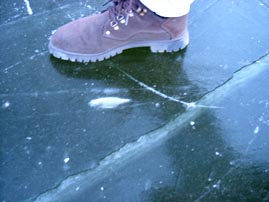
Ice covering Grenadier Lake, High Park Toronto. The ice was 8 cm thick, enough to stand on. The small patch in the ice is a dead fish, frozen into the ice. How cold should it be and for how long to have ice thick enough to stand on?
The most important assumption is that the water beneath the ice is still, such that it could have cooled down to a near freezing temperature (if it cannot, because of constant mixing for example, more heat will be available). In other words, the estimate is a lower limit. Don't try to stand on the ice just because you calculated it to be thick enough!
Having cleared that up, we can begin with the estimate. We assume that the time it takes the heat to diffuse across the ice is much shorter than the time it takes the ice to form. This implies that the temperature profile can reach its equilibrium which is a linear change from the bottom to the top. (We will later have to check the validity of this assumption). Thus, at every instant, we assume that the profile has the form: $$ T(z,x) = T_{0} \left( 1-{z \over x} \right),$$ where x is the width of the ice at the given instant. T0=-ΔT<0 is the external temperature (again, we assume it be 0 at the inner edge).
As time progresses, the thickness increases x→x+δx. This implies two things. First, freezing of a layer δx wide takes place. Second, the whole x wide layer cools. Both require energy. Per unit area of ice, it is: $$ {\delta E } = \epsilon \rho \delta x + \int_0^{z=x} \left| {d T(z,x) \over dx} \right| c \rho \delta x dz = \epsilon \rho \delta x + \Delta T \left.{z^2 \over 2 x^2}\right|_{z=0}^{z=x} c \rho \delta x = \left( \epsilon \rho + {c \rho \Delta T \over 2} \right) \delta x .$$ The absolute sign is there because the layer cools, and we are looking at the total energy we need to take out of it. ε is the latent heat required to melt ice (per unit mass) while c is the heat capacity per unit volume.
We assume that this energy leaves the ice only from its top (i.e., there is no heating from the water beneath). The heat flux leaving is thus: $$ {d E \over dt } = {\kappa \Delta T \over x} .$$ By combining the two equations, we obtain an equation for x: $$ {\kappa \Delta T \over x} = \left( \epsilon \rho + {c \rho \Delta T) \over 2} \right) {d x \over dt} ~~~\Rightarrow ~~~ x d x = {\kappa \Delta T \over \left( \epsilon \rho + {c \rho \Delta T \over 2} \right) } dt,$$ which has the solution:
$$ x_f^2 = {2\kappa \Delta T t_f \over \left( \epsilon \rho + {c \rho \Delta T \over 2} \right)} ,$$
where tf is the final time and xf is the final width. We assumed of course that freezing commences at t=0. The time required to obtain an ice layer with a width x is:
$$ t_f = {x^2 \left( \epsilon \rho + {c \rho \Delta T \over 2} \right) \over 2\kappa \Delta T } . $$
We see that there are two terms. One depends on the latent heat and another on the heat capacity. The heat capacity term is going to be more important if
$$ \Delta T \gtrsim {2 \epsilon \over c } \approx 160^\circ \mathrm{C} .$$
where we have plugged in the values of the latent heat and heat capacity of ice: ε=3.3 105 J Kg-1, c=2.1 103 J Kg-1 K-1. Clearly, the heat capacity is not important under normal terrestrial conditions. Note also that if the heat capacity is neglected, we can easily generalize the result to a time varying temperature. In such a case, the integral over dt is simple enough:
$$ \int_{t=0}^{t=t_f} \Delta T(t)dt \equiv \overline{\Delta T} t_f ,$$
where ΔT is the average temperature. In such a case, we have
$$ t_f \approx {x^2 \epsilon \rho \over 2\kappa \overline{\Delta T} } .$$
Using the actual numbers for the ice density and conductivity (ρ=920 Kg m-3, κ = 2.3 J m-1 s-1 K-1), we find that the time in days is given by
$$ (t_f/[day]) \approx 0.08 {(x/[cm])^2 \over \overline{\Delta T}/[^\circ \mathrm{C}] } .$$
If for example the average temperature is 2 degrees below freezing, then it would require about 4 days to freeze 10 cm of ice, which is about the minimum necessary to safely travel on foot (and do some ice fishing, if it's your cup of tea). If you want to drive your car (e.g., to shorten the way back home to Yellowknife), you'll need 25 days at this average temperature. For 10 degrees below freezing, it would shorten to about 5 days. Again, this assumes optimal conditions, that the water was close to freezing before the ice began forming (and in particular, that there is no constant supply of warm water such as that from a nearby stream inlet). One last point, we assumed in the calculation that the heat diffusion time through the ice is short (thereby allowing us to assume a linear temerature profile). Now we can verify that this assumption is valid. If the diffusion coefficient is λ, the diffusion time scale is tdiff = x2/λ. Since the heat diffusion coefficient of ice is λ=1.1 m2/s, tdiff ~ 2.5 hrs for 10 cm thick ice, indeed much shorter than a few days (in fact, since the thermal diffusion time is related to the thermal conductivity, one can show that this assumption is valid as long as the heat capacity, which we neglected above, is indeed not important).
Comments (8)
I really like your analysis. This would be great for a physics lesson. However, I'm concerned about the obviously incorrect result for "2 degrees below freezing" calculation. I'm sorry my math isn't strong enough to propose a better solution, but perhaps you could consider a Mark II of your calculation including some of the following points:
1./ River, lake or pond water is not pure and does not freeze at 0 degrees C. While the affect may be insignificant for very cold temperatures e.g. -20C and cooler, I think it will significantly impact your "warm" -2C calculation.
2./ Please consider depth of water. Shallow water freezes quickly, deep water doesnt. Why is this? Thermal capacity of the total volume? Or that the bottom of the deep water is > 0C, and stays > 0C due to thermal capacity of earth.
3./ Nice property of water is that if temp goes below +4C, it has a lower, not higher, density. It expands and rises to surface... hence there is always a thermal gradient in a body of water. For a cooling mass of water, when it is cold enough to freeze at the surface... it is not yet cold enough to freeze at the bottom.
Dear Ice Maiden,
Indeed, there are quite a few effects which were not considered in this analysis, as you correctly point out.
Pollutants (or just salinity) will reduce the freezing temperature. Sea water typically freeze at -2°C, so if you want to use the analysis for sea water, you will have to offset the temperature by typically this much (I write typically because not all oceans have the same salinity).
The anomaly of the water which you mention is of course very important (and interesting), and related to the latter two points you raise.
The analysis assumed that the water next to the ice is basically at freezing. This implicitly assumes that in the lake/pond is colder than 4° such that there is stratification - lower parts are warmer than the top parts. If the lake is warmer, then it has to cool isothermally - that is, with no temperature variations. This is because it cools from the top, but the colder water is heavier and thus sinks (as you correctly point out). This keeps wiping out any vertical temperature variations. Thus, if the lake is warmer than 4°C, our analysis under estimates the freezing time, because you first have to cool all the lake water.
You wrote: "and do some ice fishing, if it's you're cup of tea". I'd like to say, YOU'RE a cup of tea! Maybe you should change that to "your cup of tea".
oops. thanks! corrected (just like programers say, there's always another bug)
Never thought that it could be so technical involving so many calculations. I have been in a situation where I had to cross a frozen lake. All I could do was be careful and trust my instincts. Now I think I was lucky to have survived that.
I'm not a physicist, but I am from Canada, and there's no way I would trust ice was thick enough to walk on after only a few days at an average temp of -2C. Does your equation take into account range in temp? For example, at an average of -2, typically you would have a high temp of over 0 in the day, melting the ice that had formed, no?
Push your fat American friend out first, if he doesn't go through it should be safe to walk on.
We fat Americans tend to splay out a bit on open ice, so you'll have account for the increased surface area in your calculations.