




Submitted by shaviv on Fri, 2006-04-28 01:23
By: Nir J. Shaviv
Article originally appeared in PhysicaPlus.
Sir William Herschel was the first to seriously consider the sun as a
source of climate variations, already two centuries ago. He noted a
correlation between the price of wheat, which he presumed to be a
climate proxy, and the sunspot activity:
“The
result of this review of the foregoing five periods is, that, from the
price of wheat, it seems probable that some temporary scarcity or
defect of vegetation has generally taken place, when the sun has been
without those appearances which we surmise to be symptoms of a copious
emission of light and heat.”
— Sir William Herschel, Phil. Trans. Roy.
Soc. London, 91, 265 (1801)
Herschel
presumed that this link arises from variation in the luminosity of the
sun. Today, various solar activity and climate variations are indeed
known to have a notable correlation on various time scales. The best
example is perhaps the one depicted in fig. 1, on a centennial to
millennial time scale between solar activity and the tropical climate
of the Indian ocean (Neff et al. 2001). Another
example of a beautiful correlation exists on a somewhat longer time
scale, between solar activity and the northern atlantic climate (Bond et al. 2001). Nevertheless, the relatively small
luminosity variations of the sun are most likely insufficient to
explain this or other links. Thus, an amplifier of solar activity is
probably required to explain these observed correlations.
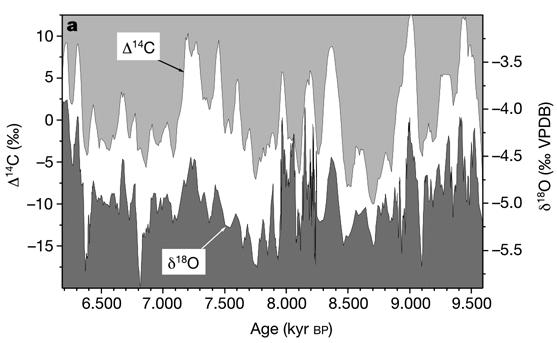
Figure 1: The correlation between solar activity—as mirrored in the
14C flux, and a climate sensitivity variable, the
18O/
16O isotope ratio from stalagmites in a cave in
Oman, on a centennial to millennial time scale. The
14C is reconstructed
from tree rings. It is a proxy of solar activity since a more active sun
has a stronger solar wind which reduces the flux of cosmic rays reaching
Earth from outside the solar system. A reduced cosmic ray flux, will in
turn reduce the spallation of nitrogen and oxygen and with it the formation
of
14C. On the other hand,
18O/
16O reflects the temperature of the Indian
ocean—the source of the water that formed the stalagmites. (Graph from
Neff et al., 2001, Copywrite by
Nature, used with permission)
Several
amplifiers were suggested. For example, UV radiation is all absorbed in
the stratosphere, such that notable stratospheric changes arise with
changes to the non-thermal radiation emitted by the sun. In fact,
Joanna Heigh of Imperial College in London, suggested that through
dynamic coupling with the troposphere, via the Hadley circulation (in
which moist air
ascends in the tropic and descends as dry air at a latitude of about
30°) the solar signal at the surface can be amplified.
Here we are interested in what appears to be a much more indirect link
between solar activity and climate.
In 1959, the
late Edward Ney of the U. of Minnesota suggested that any climatic
sensitivity to the density of tropospheric ions would immediately link
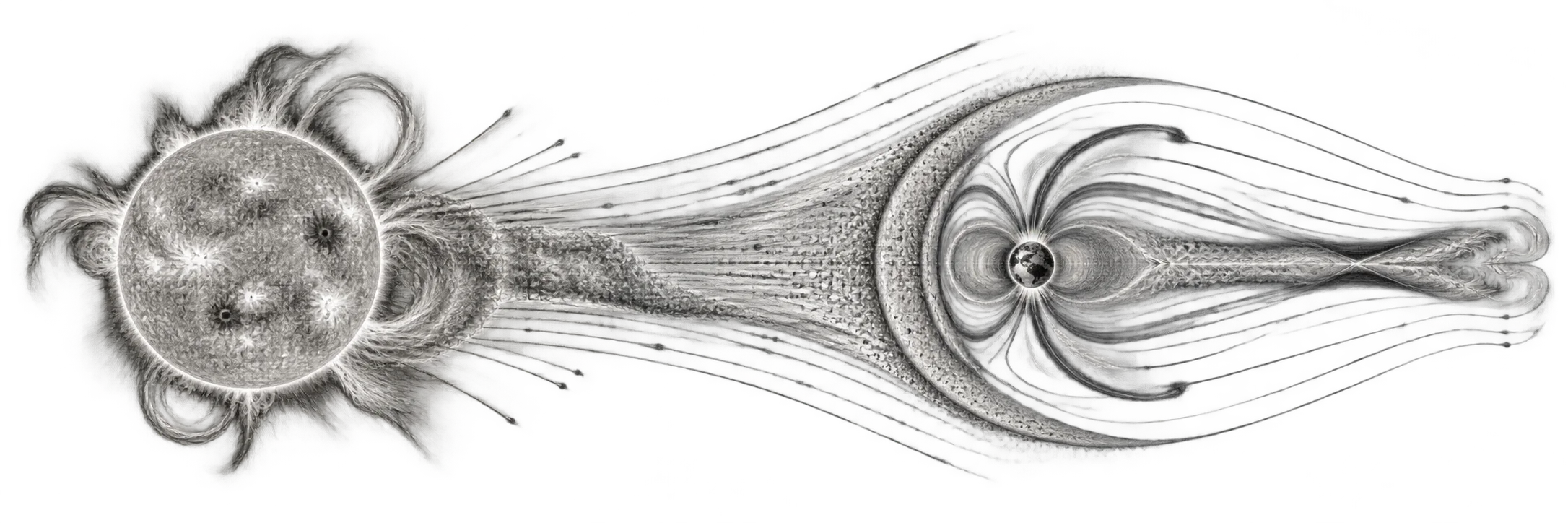
solar activity to climate. This is because the solar wind modulates the
flux of high energy particles coming from outside the solar system.
These particles, the cosmic rays, are the dominant source of ionization
in the troposphere. More specifically, a more active sun accelerates a
stronger solar wind, which in turn implies that as cosmic rays diffuse
from the outskirts of the solar system to its center, they lose more
energy. Consequently, a lower tropospheric ionization rate results.
Over the 11-yr solar cycle and the long term variations in solar
activity, these variations correspond to typically a 10% change in this
ionization rate. It now appears that there is a climatic variable
sensitive to the amount of tropospheric ionization—Clouds.
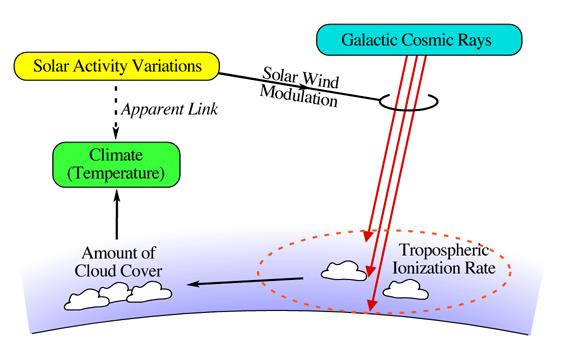
Figure 2: The cosmic ray link between solar activity and the terrestrial
climate. The changing solar activity is responsible for a varying solar
wind strength. A stronger wind will reduce the flux of cosmic ray reaching
Earth, since a larger amount of energy is lost as they propagate up the
solar wind. The cosmic rays themselves come from outside the solar system
(cosmic rays with energies below the "knee" at 1015eV, are most likely
accelerated by supernova remnants). Since cosmic rays dominate the
tropospheric ionization, an increased solar activity will translate into a
reduced ionization, and empirically (as shown below), also to a reduced low
altitude cloud cover. Since low altitude clouds have a net cooling effect
(their "whiteness" is more important than their "blanket" effect),
increased solar activity implies a warmer climate. Intrinsic cosmic ray
flux variations will have a similar effect, one however, which is unrelated
to solar activity variations.
Clouds have
been observed from space since the beginning of the 1980's. By the mid
1990's, enough cloud data accumulated to provide empirical evidence for
a solar/cloud-cover link. Without the satellite data, it hard or
probably impossible to get statistically meaningful results because of
the large systematic errors plaguing ground based observations. Using
the satellite data, Henrik Svensmark of the Danish National Space
Center in Copenhagen has shown that cloud cover varies in sync with the
variable cosmic ray flux reaching the Earth. Over the relevant time
scale, the largest variations arise from the 11-yr solar cycle, and
indeed, this cloud cover seemed to follow the cycle and a half of
cosmic ray flux modulation. Later, Henrik Svensmark and his colleague
Nigel Marsh, have shown that the correlation is primarily with low
altitude cloud cover. This can be seen in fig. 3.
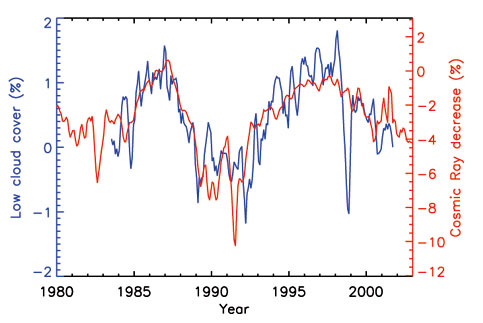
Figure 3: The
correlation between cosmic ray flux (orange) as measured in Neutron
count monitors in low magnetic latitudes, and the low altitude cloud
cover (blue) using ISCCP satellite data set, following
Marsh
& Svensmark, 2003.
The
solar-activity – cosmic-ray-flux – cloud-cover correlation is quite
apparent. It was in fact sought for by Henrik Svensmrk, based on
theoretical considerations. However, by itself it cannot be used to
prove the cosmic ray climate connection. The reason is that we cannot
exclude the possibility that solar activity modulates the cosmic ray
flux and independently climate, without any casual link between the
latter two. There is however separate proof that a casual link exists
between cosmic rays and climate, and independently that cosmic rays
left a fingerprint in the observed cloud cover variations.
To begin with,
climate variations appear to arise also from intrinsic cosmic ray flux
variations, namely, from variations that have nothing to do with solar
activity modulations. This removes any doubt that the observed solar
activity cloud cover correlations are coincidental or without an actual
causal connection. That is to say, it removes the possibility that
solar activity modulates the cosmic ray flux and independently the
climate, such that we think
that the cosmic rays and climate are related, where in fact they are
not. Specifically, cosmic ray flux variations also arise from the
varying environment around the solar system, as it journeys around the
Milky Way. These variations appear to have left a paleoclimatic imprint
in the geological records.
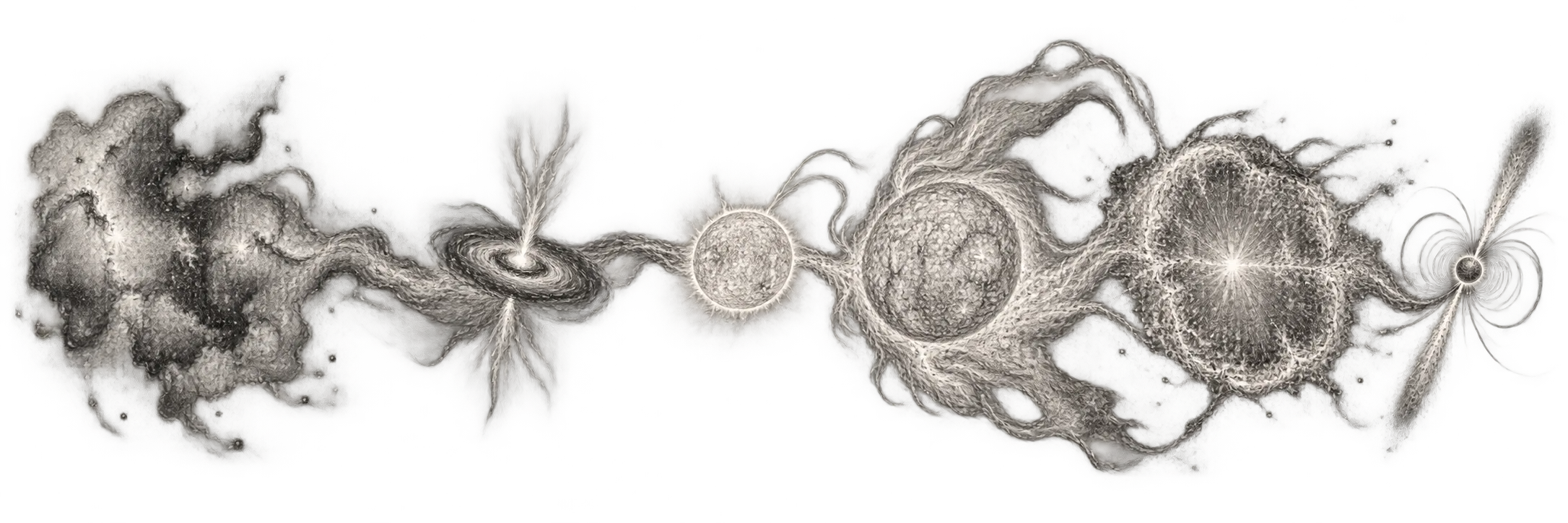
Cosmic Rays, at
least at energies lower than 1015eV, are
accelerated by supernova remnants. In our galaxy, most supernovae are
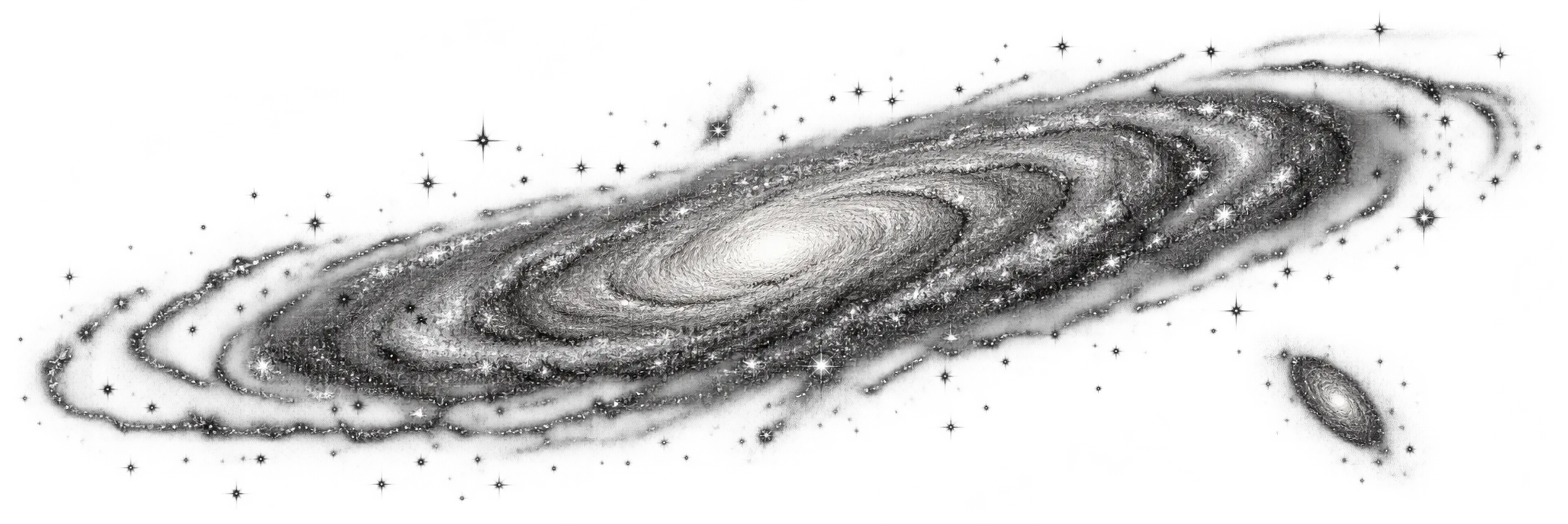
the result of the death of massive stars. In spiral galaxies like our
own, most of the star formation takes place in the spiral arms. These
are waves which revolve around the galaxy at a speed different than the
stars. Each time the wave passes (or is passed through), interstellar
gas is shocked and forms new stars. Massive stars that end their lives
with a supernova explosion, live a relatively short life of at most 30
million years, thus, they die not far form the spiral arms where they
were born. As a consequence, most cosmic rays are accelerated in the
vicinity of spiral arms. The solar system, however, has a much longer
life span such that it periodically crosses the spiral arms of the
Milky Way. Each time it does so, it should witness an elevated level of
cosmic rays. In fact, the cosmic ray flux variations arising from our
galactic journey are ten times larger than the cosmic ray flux
variations due to solar activity modulations, at the energies
responsible for the tropospheric ionization (of order 10 GeV). If the
latter is responsible for a 1°K effect, spiral arm passages should
be responsible for a 10°K effect—more than enough to change the
state of earth from a hothouse, with temperate climates extending to
the polar regions, to an icehouse, with ice-caps on its poles, as Earth
is today. In fact, it is expected to be the most dominant climate
driver on the 108 to 109
yr time scale.
It was shown by
the author (Shaviv 2002, 2003),
that these intrinsic variation in the cosmic ray flux are clearly
evident in the geological paleoclimate data. To within the
determinations of the period and phase of the spiral-arm climate
connection, the astronomical determinations of the relative velocity
agree with the geological sedimentation record for when Earth was in a
hothouse or icehouse conditions. Moreover, it was found that the cosmic
ray flux can be independently reconstructed using the so called
"exposure ages" of Iron meteorites. The signal, was found to agree with
the astronomical predictions on one hand, and correlate well with the
sedimentation record, all having a ~145 Myr period.
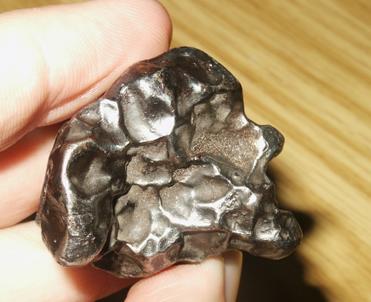
Figure 4: An Iron
meteorite. A large sample of these meteorites can be used to
reconstruct the past cosmic ray flux variations. The reconstructed
signal reveals a 145 Myr periodicity. The one in the picture is part of
the Sikhote Alin meteorite that fell over Siberia in the middle of the
20th century. The cosmic-ray exposure age of
the meteorite implies that it broke off its parent body about 300
Million years ago.
In a later
analysis, with Ján Veizer of the University of Ottawa and the
Ruhr University of Bochum, it was found that the cosmic ray flux
reconstruction agrees with a quantitative reconstruction of the
tropical temperature (Shaviv & Veizer, 2003).
In fact, the correlation is so well, it was shown that cosmic ray flux
variations explain about two thirds of the variance in the
reconstructed temperature signal. Thus, cosmic rays undoubtedly affect
climate, and on geological time scales are the most dominant climate
driver.
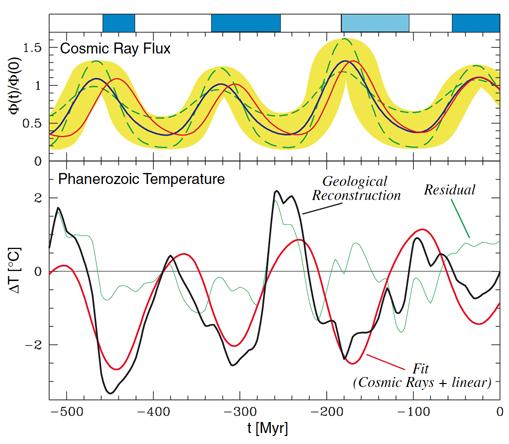
Figure 5: Correlation
between the cosmic ray flux reconstruction (based on the exposure ages
of Iron meteorites) and the geochemically reconstructed tropical
temperature. The comparison between the two reconstructions reveals the
dominant role of cosmic rays and the galactic "geography" as a climate
driver over geological time scales. (
Shaviv
& Vezier 2003)
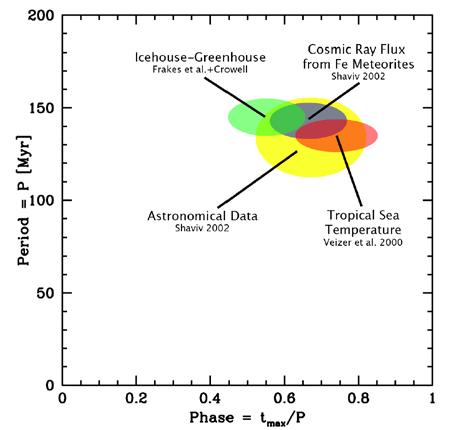
Figure 6: A summary
of the 4 different signals revealing the cosmic ray flux climate link
over geological time scales. Plotted are the period and phase (of
expected peak coldness) of two extraterrestrial signals (astronomical
determinations of the spiral arm pattern speed and cosmic ray flux
reconstruction using Iron meteorites) and two paleoclimate
reconstruction (based on sedimentation and geochemical records). All
four signals are consistent with each other, demonstrating the
robustness of the link. If any data set is excluded, a link should
still exist.
Recently, it
was also shown by Ilya Usoskin of the University of Oulu, Nigel Marsh
of the Danish Space Research Center and their
colleagues, that the variations in the amount of low altitude cloud
cover follow the expectations from a cosmic-ray/cloud cover link (Usoskin et al., 2004). Specifically, it was found
that the relative change in the low altitude cloud cover is
proportional to the relative change in the solar-cycle induced
atmospheric ionization at the given geomagnetic latitudes and at the
altitude of low clouds (up to about 3 kms). Namely, at higher latitudes
were the the ionization variations are about twice as large as those of
low latitudes, the low altitude cloud variations are roughly twice as
large as well.
Thus, it now
appears that empirical evidence for a cosmic-ray/cloud-cover link is
abundant. However, is there a physical mechanism to explain it? The
answer is that although there are indications for how the link may
arise, no firm scenario, at least one which is based on solid
experimental results, is yet present.
Although above
100% saturation, the preferred phase of water is liquid, it will not be
able to condense unless it has a surface to do so on. Thus, to form
cloud droplets the air must have cloud condensation nuclei—small dust
particles or aerosols upon which the water can condense. By
changing the number density of these particles, the properties of the
clouds can be varied, with more cloud condensation nuclei, the cloud
droplets are more numerous but smaller, this tends to make whiter and
longer living clouds. This effect was seen down stream of smoke stacks,
down stream of cities, and in the oceans in the form of ship tracks in
the marine cloud layer.
The suggested
hypothesis, is that in regions devoid of dust (e.g., over the large
ocean basins), the formation of cloud condensation nuclei takes place
from the growth of small aerosol clusters, and that the formation of
the latter is governed by the availability of charge, such that charged
aerosol clusters are more stable and can grow while neutral clusters
can more easily break apart. Several experimental results tend to
support this hypothesis, but not yet prove it. For example, the group
of Frank Arnold at the university of Heidelberg collected air in
airborne missions and found that, as expected, charge clusters play an
important role in the formation of small condensation nuclei. It is yet
to be seen that the small condensation nuclei grow through accretion
and not through scavenging by larger objects. If the former process is
dominant, charge and therefore cosmic ray ionization would play an
important role in the formation of cloud condensation nuclei.
One of the
promising prospects for proving the "missing link", is the SKY experiment being conducted in
the Danish National Space Center, where a real "cloud chamber" mimics
the conditions in the atmosphere. This includes, for example, varying
levels of background ionization and aerosols levels (sulpheric acid in
particular). Within a few months, the experiment will hopefully shed
light on the physical mechanics responsible for the apparent link
between cloud cover and therefore climate in general, to cosmic rays,
and through the solar wind, also to solar activity.
[Added Note (4 Oct. 2006): The experimental results indeed confirm a link]
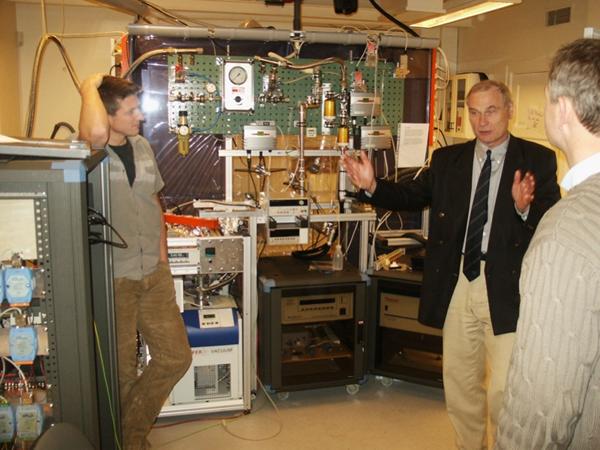
Figure 7: The
Danish National Space Center SKY
reaction chamber experiment. The experiment was built with the goal of
pinning down the microphysics behind the cosmic ray/cloud cover link
found through various empirical correlations. From left to right: Nigel
Marsh, Jan Veizer, Henrik Svensmark. Behind the camera: the author.
The
implications of this link are far reaching. Not only does it imply that
on various time scales were solar activity variations or changes in the
galactic environment prominent, if not the dominent climate drivers, it
offers an explanation to at least some of the climate variability
witnessed over the past century and millennium. In particular, not all
of the 20th century global warming should be attributed to
anthropogenic sources, since increased solar activity explains through
this link more than half of the warming.
More information can be found at:
-
A general article on the cosmic ray climate link over geological time scales.
-
Henrik
Svensmark's web site, including various
publications on the cosmic-ray/cloud link.
- The
awaited results of the Danish SKY
cloud experiment will be reported on their website
within several months.
Notes
and References:
* On solar
activity /climate correlation:
- For the
first suggestion that solar variability may be affecting climate, see:
William Herschel, "Observations
tending to investigate the nature of our sun, in order to find causes
or symptoms of its variable emission of light and heat", Phil.
Trans. Roy. Soc. London, 91, 265 (1801). Note that Herschel
suspected that it is variations in the total output which may be
affecting the climate (and with it the price of wheat).
- Perhaps the most beautiful correlation between a solar
activity and climate proxies can be found in the work of U. Neff et
al., "Strong coherence between solar
variability and the monsoon in Oman between 9 and 6 kyr ago", Nature
411, 290 (2001).
- Another beautiful correlation between solar activity
and climate can be seen in the work of G. Bond et al., "Persistent Solar Influence on North
Atlantic Climate During the Holocene", Science,
294, 2130-2136, (2001).
* On cosmic ray
and cloud cover correlation:
- The paper by Henrik Svensmark, reports the
correlation between cosmic ray flux variations and cloud cover changes:
H. Svensmark, "Influence of Cosmic
Rays on Earth's Climate", Physical
Review Letters 81, 5027 (1998).
- The specific correlation with low altitude cloud
cover is discussed in N. Marsh and H. Svensmark, "Low Cloud Properties Influenced by Cosmic
Rays", Physical
Review Letters 85, 5004 (2000).
- Further analysis including the relative role of CRF
variations vs. el-niño can be found in: N. Marsh and H.
Svensmark, "Galactic cosmic ray and El Niño-Southern Oscillation
trends in International Satellite Cloud Climatology Project D2
low-cloud properties", J.
of Geophys. Res., 108(D6), 6 (2003).
- The analysis showing the geographic signature of
the cosmic ray flux variations in the low altitude cloud cover
variations can be found it: I. Usoskin et al., "Latitudinal dependence of low cloud
amount on cosmic ray induced ionization", Geophysical
Research Letters 31, L16109 (2004).
* On cosmic ray
climate correlations on Geological time scales:
- The suggestion that cosmic ray flux variations spiral
arm passages could give rise to ice-age epochs is found at: N. Shaviv, "Cosmic Ray Diffusion from the Galactic
Spiral Arms, Iron Meteorites, and a Possible Climatic Connection",
Physical
Review Letters 89, 051102, (2002).
- A highly detailed analysis, including the cosmic ray
reconstruction using iron meteorites is found in: N. Shaviv, "The spiral structure of the Milky Way,
cosmic rays, and ice age epochs on Earth", New
Astronomy 8, 39 (2003).
- The analysis of Shaviv & Veizer
demonstrates the primary importance of comic ray flux variations over
geological time scales, and with it, place a limit on climate
sensitivity: N. Shaviv & J. Veizer, "A Celestial driver of Phanerozoic
Climate?", GSA
Today 13, No. 7, 4, 2003.
Comments
slavalava
Sat, 2006-12-02 14:14
cosmic radiation
hello nir !
I wonder if you can direct me please to an article on the internet in hebrew that talks about cosmic ray or cosmic radiation and its influence on the atmosphere
thank,slava
shaviv
Sat, 2006-12-02 14:33
There isn't a lot of information in hebrew...
The only thing I know is this short, crude and outdated summary. Sorry.
Frédéric (not verified)
Sun, 2007-02-04 18:39
Translation in French
Hello Nir,
Nice article. May I get your permission to translate it in French on my blog please ?
shaviv
Sun, 2007-02-04 23:41
Go ahead
As long as the source will be referenced/linked (so that at least some visitors will be able to check the faithfulness of the translation ;-)
(C'est un quelque chose que je ne peux pas faire avec mon Français...)
Frédéric (not verified)
Mon, 2007-02-05 10:33
Thank you Nir!
Thank you Nir!
Source links are always provided on my blog. Il faut rendre à César ce qui appartient à César, comme on dit.
BTW, I saw your posts on Real Climate. You prevailed, by far! Keep up with the good work.
Antoine (not verified)
Tue, 2008-11-18 07:39
sources
And I must think you for sourcing your blog. Not enough websites do this proficiently or in a way that is resourceful.
William Sellyey (not verified)
Sun, 2007-04-29 03:05
Climate control
You do beautiful science; keep up the good work.
The results in your publications and the ones presented in your blog give no reason to believe that anthropogenic CO2 or any other emissions are involved in global warming. The difference between measured global temperature change for the 20th century, .57±.17ºC and your calculation, 0.47±.19ºC is 0.10±.25ºC and this is consistent with zero. It also seems clear (as you have pointed out) that the IPCC reports do not predict anything useful because they cannot explain the warming that has happened in this century. Greatly increased support for research on the effect of cosmic rays and their possible interactions with human caused emissions is needed to accurately pin down what, if any, anthropogenic effects will develop in the future. It seems likely to me that, if there is an anthropogenic cause, CO2 will not be the main problem.
The CO2 model is now the politically correct model. It is a freight train that is moving with a huge political momentum and it will be extremely difficult to influence. Do you have any idea of how to stop it from carrying the world into huge pointless expenditures?
I believe that this is extremely important for countries like the USA and China where coal could provide all needed energy for a few centuries. It may be true that this could lead to additional global warming, but there is no evidence for it now.
Assuming the link between cosmic rays and cloud formation hold true, one can imagine engaging in planetary climate control. I estimate that the total cosmic ray power hitting the earth in the range of 10 to 11 GeV is 260 MW. The design of a 10 GeV, 26MW accelerator with this sort of power on the earth’s surface is not a great challenge. Putting one in orbit (perhaps in a geo-synchronous orbit) would be a challenge but probably achievable with existing technology. Once NASA gets its new heavy lift rocket working this accelerator could be assembled on the ground and then put in orbit in pieces. A wild guess on the cost is something like $20 billion (US). A group at Los Alamos National Laboratory (USA) has performed a proof of principle of small accelerator operating in orbit.
It is possible that weather or climate altering accelerators could be operated on the ground. The potential problem is that the energy of particles would be too degraded by the time they reach altitudes where cloud formation takes place. I suspect one could do useful experiments by taking existing machines and directing their output upward. A potential problem with this is “sky shine” in which neutrons are generated by the beam and travel back to the ground thus exposing the public to radiation.
I am interested in you comments.
shaviv
Fri, 2007-05-04 11:04
I actually did think of this
I actually did think of this idea a few years ago. The problem with an accelerator operating at high energies is that their efficiency is very low (for every watt of beam energy, the accelerator needs quite a few orders of magnitude more energy drawn from the power grid). I am quite sure that when you include that, you'll find this solution less favorable...
In fact, it is actually quite a tricky question. How could one can ionize large volumes with high efficiency? The ionizing hard UV for example, is absorbed over a very small atmospheric distance, making it hard to ionize large volumes with it.
Nir
William Sellyey (not verified)
Sun, 2007-05-06 10:51
Accelerator Efficiency
Hello Nir
When accelerators were first being developed, their efficiency was probably as low as you describe. There was a tremendous push to increase the power and efficiency of accelerators during the Star Wars era and later to develop high power proton machines for the accelerator production of tritium (ATP) and accelerator transmutation of waist (ATW). The accelerator technology used in these was largely radio frequency accelerator cavities driven by Klystrons. The power usage path in these is 60 Hz AC (plug) power to DC power with about 80% efficiency, klystron to rf power with about 65% efficiency (http://capp.iit.edu/~capp/workshops/epem/Transparencies/Guidee.pdf), to cavity with about 80% efficiency, to beam with about 60% efficiency (a room temperature electron linac with 60% efficiency that was actually operated in the 90’s is described here: http://epaper.kek.jp/p89/PDF/PAC1989_0183.PDF). This is an overall efficiencies of about 25% for the accelerating process. Thus to generate a 26MW beam 104MW of plug power will be required. The accelerator cavities could be either normal or superconducting. In terms of power requirements the cavity type does not matter, but the accelerator length could be cut in half or third because of the higher gradients achievable with superconducting cavities. The proton injection system would need an additional 10MW.
To deal with the focusing and deflection magnets a superconducting system could be used. An 8GeV proton linac design (http://tdserver1.fnal.gov/8gevlinacPapers/ParameterList2005/CD0_Parameter_List_Current_Version.pdf) needs 3MW of wall power to its cryogenic system to cool the magnets. Thus magnets for a 10GeV linac could be cooled by about a 5MW system. The superconducting magnets will need power to build up the field and to adjust the field during the commissioning and tuning process. Once the magnets are at their final value they can be disconnected from the power supplies and no power will be needed indefinitely. The power supply can be connected to another magnet. Thus add 5 MW to accommodate magnet current requirements. An additional 5MW could take care of instrumentation, control and communication.
Some additional power will be needed to expand and raster the output beam. Also the Klystrons will need cooling. Add another 5 MW for these. Probably no vacuum system will be needed but a system for radiating waist heat will be required. The whole thing will need to be held together by a large frame with vibration and orientation control and the whole system will need to be shaded from the sun so add 5MW. The total comes to 139MW. This is a huge amount of power but it could be supplied with either a nuclear power plant or solar cells. Assuming a solar cell power output of 200W/m2, 0.7km2 will be needed.
As you point out, it will be important to spread out the proton beam so the atmospheric ionization will be efficiently dispersed. There are two ways this is usually done. One is to raster the beam with two perpendicular varying magnetic fields. The other is to use a powerful quadrupole magnet to disperse the beam. Probably both would be used and I do not think there would be any difficulty spreading out the beam.
It is not clear that protons would be the most effective way of causing the ionization needed for cloud formation. Much of the cosmic ray shower development involves the primary proton knocking out nucleons from a nucleus and these, in turn, do the same thing. Disassembling a nucleus requires energy much of which will not be unavailable for ionizing the atmosphere. Using electrons would alleviate this problem and possibly cut the required primary power in half or even by a factor of ten. There is extensive software available for studying this question and that would need to be done before any realistic design is attempted.
Something like 10 or a 100 of these systems would be needed to completely replace all the cosmic rays that are involved in cloud formation. All of this sounds exorbitant but it could be done with the appropriate motivation like avoiding the displacement of a billion people. It is possible that one of these systems could be used to influence the paths of hurricanes so they can be kept away from land. If so it would not take long for this system to pay for itself.
Bill
Brian H (not verified)
Wed, 2011-08-03 01:28
Creating clouds
Very clever, but perverse. Cooling the planet, notwithstanding the inane alarmism of the AGW agitators, is the last thing that should be attempted. Cool = more death, warm = more life.
Anonymous (not verified)
Wed, 2011-09-21 12:06
I am not sure if there is a
I am not sure if there is a relationship between your comments and the following link.. I am not an expert on the matter, but thought it may be worth a closer examination.. http://www.haarp.alaska.edu/haarp/ion4.html
JC (not verified)
Fri, 2007-06-15 03:19
Cosmic ray trends over the last 50 years
The whole problem with the theory that cosmic rays (or lack thereof) are driving global warming is that cosmic radiation has shown no trend over the last 50 years. This has led the Max Planck Institute to conclude that cosmic ray flux and temperature followed each other up to 1970 but there has been no correlation between temperature and cosmic ray flux since 1970. So even if cosmic rays are linked to cloud formation, all they'll find is the cloud formation 50 years ago is similar to now and has little to no impact on the last 30 years of long term global warming.
shaviv
Sat, 2007-06-30 20:46
There is no problem since there is a trend
The key point to understand is that earth has a finite heat capacity. This implies that the whole climate system is like a low pass filter. Modulations on the 11 year solar cycle are damped, leaving only 10 or 20% of the temperature variations that would have been seen if the system could have reached equilibrium. Over 50 years, it is of order 50%, and over a century, about 80%. This is all because it takes time for the oceans to heat and cool. The last 20% or so, are obtained only after waiting several centuries, letting the ice-caps adjust.
Having said that, If you look at the graphs you linked, you'll see that there is a secular trend which is as large as the the 11-year modulations (compare solar maximum / CRF minimum of 1970 to that of 1990). However, because the 11-years are damped, you mostly see the long term trends. (Though if you look carefully, there ares still 0.1°C variations which lag the 11-year solar cycle by about 2 years, but that's besides the point).
Anyway, the long term trend seen in the cosmic ray flux, after you average out the 11-year solar cycle, is an increase from the 50's to the 70's (because of a decreased solar activity), and then a decrease from the 70's to 90's (i.e., increase in solar activity. The last cycle was weaker (and so was the minimum in the low altitude cloud cover) which should translate into a reduced warming... and indeed the heat content in the upper oceans decreased, and GW stopped in 2001.
Another point to note is that solar activity in the first 50 years of the 20th century was significantly lower than the last 50 years, this implies that the long term behavior should be an increase in the global temperature. This however you cannot see directly in the cosmic ray flux, since those were recorded only from the middle of the 20th century.
Last, I never said that cosmic rays explain all the warming. My best estimate is that it explains about 2/3's of the warming. More about it in this paper.
Michal (not verified)
Sun, 2007-06-24 07:37
Last 50 years...
Hi Nir,
Could you please comment on the propensity of your research to be used as some kind of "proof" that climate change is not currently being driven by GHGs. In particular, given that there has been no trend in the sunspot count or cosmic ray flux over the last 50 years[1], while the global temperature has increased by 0.5-0.6°C[2], how can one seriously claim that your work shows solar activity to be the major driver of climate change today and over the last 50 years?
Regards,
Michal
[1] See here for example: http://neutronm.bartol.udel.edu/modplot.html
[2] http://www.globalwarmingart.com/wiki/Image:Instrumental_Temperature_Record_png
shaviv
Sat, 2007-06-30 20:55
see my reply
a few comments above.
(Basically, there is a trend)
aaron (can't login) (not verified)
Wed, 2007-07-11 19:41
There is a trend.
Even Peter Stott agrees!
http://www.sciencemag.org/cgi/content/full/290/5499/2133
Science 15 December 2000:
Vol. 290. no. 5499, pp. 2133 - 2137
DOI: 10.1126/science.290.5499.2133
External Control of 20th Century Temperature by Natural and Anthropogenic Forcings
Peter A. Stott,1* S. F. B. Tett,1 G. S. Jones,1 M. R. Allen,2 J. F. B. Mitchell,1 G. J. Jenkins1
"The solar and volcanic forcings we use are derived from reconstructions based on proxy data and are therefore also subject to considerable uncertainties, although recent explosive volcanic eruptions are likely to have cooled climate, and independent records of solar activity levels inferred from the cosmogenic isotope 10Be (43) and geomagnetic records (44) provide support to reconstructions (22, 45) that show generally increasing solar activity during the 20th century (12)."
Demesure (not verified)
Thu, 2007-07-12 13:11
Last Locwood's paper
Hello Dr Shaviv,
Thanks for your very clear presentation. I have also read your explanation on recent years' correlation and it's rather convincing since the temperature plateau over the last 5 years is rather unprecedented, whatever it means (I haven't seen any over the last 30 years).
Could you please comment for laymen on the last paper from Lockwood on the "no correlation between CR and temperature after 1985" and widely spread all over the blogosphere (may be in a new post ?).
BTW, you must know that the Lyman's paper on ocean cooling has been corrected last March: no more cooling but no heating either.
Anonymous (not verified)
Mon, 2007-08-13 10:37
Cosmic rays - IPCC report
On page 193 in The AR4 IPCC report there is a reference to Kristjansson and Kristiansen,2000 and Sun and Bradley,2002 where they find no correspondance between cosmic rays and clouds after 1991 and low level clouds after 1994. Can you comment on that.
shaviv
Sun, 2007-08-19 18:27
Sure.
- Indeed, Kristjansson and Kristiansen (2000) critically discuss the GCR cloud link. Interestingly, however, they note that a correlation between low clouds and GCR does exist, but discard the correlation as real since no physical mechanism is apparently known. Today, however, more theoretical ideas together with experimental results do exist to indicate that atmospheric ionization, which is controlled by the GCR flux, can affect the formation efficiency of cloud condensation nuclei, and with it the characteristics of cloud cover (e.g., Yu 2002, for a theoretical paper, and Eickorn et al. 2003, Harrison & Aplin 2000 and Svensmark et al. 2007, for experimental results).
-
As for Sun and Bradley [2002, JGR], they basically generalize the lack of correlations over small local regions (much less than 10%) to the whole globe. For example they find a lack of correlation between certain cloud constructions over USA and GCR. If one studies the correlation map of Marsh & Svensmark [2003] then there is even a small negative correlation between cloud cover over the USA and GCR. However there are nice correlations if one looks globally. As for the specific comment where they find no correlation between clouds and GCR going back to the 50’s, it is necessary to go to the source of their data. Norris [1999] pointed out the possibility of numerous inhomogeneities both temporally and spatially that may be present in the ship-based observations of clouds. In fact, he stated that it “remains uncertain whether the observed increases in global mean ocean total and low cloud cover between 1952 and 1995 are spurious. Corroboration by related meteorological parameters and satellite-based cloud datasets should be required before the trends are accepted as real.”.
And for fun, here are my comments on other critiques of the CRF/climate link:Anonymous (not verified)
Sun, 2007-08-19 21:04
Milankovitch cycles
I was wandering if the different Milankovitch cycles could affect where ionising myons actually hit the troposhere. For example the axial tilt could make the landmasses point more to the sun and the ionising process controlled by GCR would be more efficient since more of them would hit the large oceans; vice versa would both reduce the impact of variations in GCR and reduce the cooling associated with a particular amount of incoming GCR. Have you seen any studies on this?
shaviv
Wed, 2007-08-22 11:33
It should be a very small
It should be a very small effect.
2° tilt variation would be a ~2/90 effect on typically 5°C-10°C variations (the whole range of the CRF/climate effect). That is, something of order 0.1 to 0.2°C, which is not observable over these time scales.
Rikard Bergsten (not verified)
Sun, 2007-08-19 21:21
Milankovitch cycles again
Hello, with reference to my earlier question I noted that the formation of certain types of clouds http://en.wikipedia.org/wiki/Noctilucent_cloud is highly correlated to the passing of the solar systems invariable plane (the plane that represents the angular momentum of the system). Also, noted, that the main effect of the milakovitch cycles are the 100Kyr cycle, but alas, it has been hard to explain why the relatively weak forcing associated with variances in the inclination of earths orbit relative to the invariable plane has such a big impact. Put the two peases together: passing the invariable plane cause an clear effect on clouds, and shifting the inclination in and out of the invariable plane might then also be expected to have an impact on cloud formation. (N.b. Noctiluent clouds in themselves can hardly have much of a climate impact, but it would be reasonable to think that other more common clouds could be affected to.)
shaviv
Wed, 2007-08-22 10:56
You are correct that
You are correct that Milankovitch has a hard time explaining the variations. At this point I don't want to claim any claims, however, I am not sure how much of the so called correlations that they see is real, and how much from the very fluid calibration that they use... (using the Milankovitch cycles to calibrate the time scale in the ice-cores and then use the cycles for comparison is problematic, to say the least).
As for your suggestion that dust from the solar system's invariable plane could cause climate variations, it is good! But it was suggested before by Muller and MacDonald
See:
A Causality problem for Milankovitch" (need science mag subscription) or from Muller's website: < a href="http://muller.lbl.gov/papers/Causality.pdf">A Causality problem for Milankovitch" and Glacial Cycles and Astronomical Forcing
René Mérou (not verified)
Tue, 2007-08-28 05:16
traslation to spanish and NASA errors
You can find this article traslated in spanish in my weblog: Los rayos cósmicos y el clima
Just one day after I ended the traslation I was told about some errors in the temperatures from the NASA. See this link: Blogger Finds Y2K Bug in NASA Climate Data .
Can you giveme your opinión on the relevance of that errors?
Than you for the publication this weblog and the articles, its all very interesting.
Frank (not verified)
Sun, 2007-09-23 00:25
Supernovas
It is known that most cosmic rays are originated in supernova explotions. Last year the sn 2006 gy, the most powerful supernova ever registered, exploded.
We should expect an increase of cosmic rays and, consecuently an increase in cloud formation.
Is there any evidence on such fenommenum, or shall we wait to see it later ? This would be a good argument to proof the theory against the anthropogenic climate change.
MSE29 (not verified)
Thu, 2008-01-03 00:52
SN 2006gy very important
The supernova 2006gy had an influence on temperatures in mid europe unique Hanover in Germany.
In september 2006 temperatures rised quite suddenly. After 70 days after SN exploded, the temperature was on highest point. From october till february, nearly 100-120 days, temperatures was continually above +3K.
At the beginng temperatures went up comparable with R-Band of SN 2006gy. After 120 days, in february, R-Band sank gently comparable with temperatures.
MSE29 (not verified)
Tue, 2008-04-01 00:56
SN 2006gy a very important supernova
which had a bearing on mid europes climate for a half year. I do not know what type of radiation it was. But I know it had bearing on mid europes temperatures. You can find the figure of SN 2006gy R-Band in Nathan Smiths publication. You can find the "31-day running mean of daily temperature departures"-figure with high significantly correlation on this website: http://www.cpc.noaa.gov
or here:
http://www.mse29.de/wetter/klimadaten/SN2006gy_tn10338_1yr_2007-07-31.gif
I mean that one kind of radiation by SN 2006gy on an time intervall up to 120 days have a climatic influence.
Nir Shaviv, cosmic rays have not only an influence on geological time scales. It must have a bearing on weather in short time scales, too. A lot of very different weather situations makes the climate we have.
Antony (not verified)
Mon, 2008-04-07 14:15
About the cosmic - climate correlation
Hi!
First of all congratulations for the good work that you do!
The thing is that I read the theory about the cosmic - climate correlation, and I have quite a basic question as long for the exact role of the cosmic ray particles, meaning: we know that water vapour condenses on aerosols in the atmosphere, creating the condensation nuclei. The cosmic ray particles work let's say like a "glue" that puts together all the already formed condensation nuclei in the atmospheric air, creating therefore bigger condensation nuclei and finally the clouds, or the cosmic particles act as aerosols on their own, on which the water vapour condenses? Also, the cosmic ray particles that do the job are the electrons or the muons? And why the low level clouds are affected?Because at such heights the cosmic particles have lost the most of their energy via ionisation, and therefore they are capable of getting part in the whole mechanism?
I believe that I have read somewhere, that when we have a big influx of cosmic ray particles we have a bigger concentration of aerosols. How can this be related to the above, and what's the whole picture (in a few words off course:) anyway?
Thanks a lot for your time, and trully looking forward for your reply..
Yours Antony
DavidLHagen
Wed, 2009-04-15 19:49
Please update URLs
Thanks for very useful post. Please update links to:
# Henrik Svensmark's web site, including various publications on the cosmic-ray/cloud link.
# The awaited results of the Danish SKY cloud experiment will be reported on their website within several months.
Wes (not verified)
Tue, 2009-04-28 21:15
Very refreshing to see some
Very refreshing to see some real science being done for a change (no pun intended).
Pages