
Physicsstandard
Estimating the Dipole Radiation Power using Dimensional Analysis
An electric dipole is characterized by the dipole moment which depends on both the charge and a the separation (but not independently on each). Estimating the power radiated by an oscillating electric dipole is an excellent example for the usage of dimensional…
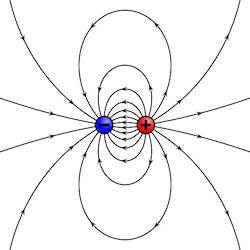
An electric dipole is characterized by the dipole moment which depends on both the charge and a the separation (but not independently on each).
Estimating the power radiated by an oscillating electric dipole is an excellent example for the usage of dimensional analysis.
Let us assume we have a dipole oscillating with frequency . The relevant equations to describe the problem are obviously Maxwell’s equations. Thus, unlike the electrostatic description of the Hydrogen Atom, the speed of light will be relevant for the solution. Moreover, instead of an expression that depends on the electron charge , we will seek one which depends on the dipole moment , which is charge times displacement: . The expression will obviously depend on as well. It wont depend on because the problem is not a quantum mechanical one. Likewise, the expression will also be independent of because the problems is unrelated to gravity.
Let us look at and the dimensionality of the relevant variables.
We seek an emitted power:
The variables upon which it can depend are
and the dipole moment:
In order to have gr in the final result for , we therefore need to take the first power of . Thus
To get rid of the cm, we must multiply by , and obtain:
Last, by multiplying by we will get a dimensionless number:
Thus, to within a dimensionless constant, the power emitted is
To determine the actual prefactor it would be necessary to solve the full problem.