
Parhelic Circles, Ice Haloes and Sun dogs over Jerusalem
Blog topic:
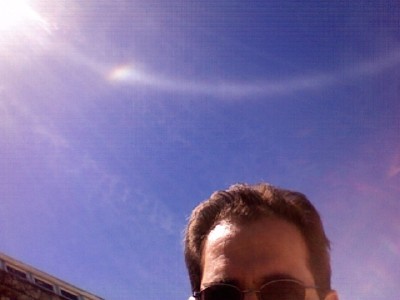
A Parhelic Circle
So, how does this halo form? The fact that the parhelic circle "sees" the horizon implies that gravity has to play a role in aligning the ice crystals. A little digging, reveals that up to 20% of the ice crystals can be horizontally aligned hexagonal plates. Interestingly, when these fall they align themselves such that they maximize the drag force. This is very similar to falling leaves. Any small rotation of the ice crystal generates a net force on the windward side of the crystal (i.e., the one facing the wind as it falls down) which is larger than the drag on the leeward side of the crystal. This gives rise to a net torque which rotates the crystal back to its horizontal direction.
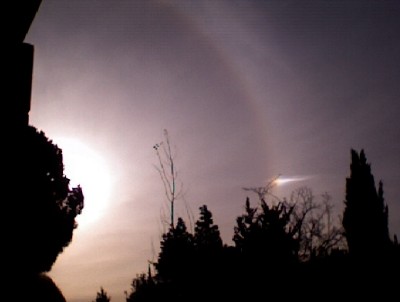
A 22° halo with a sun dog.
One interesting result of this required alignment is that the halos are generally smeared and are therefore achromatic (without any color). That is, at any given direction, two light rays at two different colors can be reflected from two crystals aligned slightly differently. The notable exception is the reddish hue in the inner edge of the halo. Because the index of refraction at the red wavelengths is the smallest, the red cannot be smeared over by other colors at the smallest angles of deflection.
More weather stuff on sciencebits.com can be found here.
Comments (5)
That's really amazing stuff. Thanks for sharing the pics!
Paul E.
Agreed. Where the heck did you get those pics anyway? Nice site layout also.
With the MacBook webcam...
Very nice captured halo's! I didn't knew that they appeared by the sun and i am from nothern europe. lol
But nice photo's and informative story, every day i learn something. :D
thank you,
Jade
Those are amazing photographs. I wonder are their any superstitions historically associated with these circles? Its cool to get the scientific breakdown as well but even though I get (kind of) the science behind it I am still in awe of the beauty.