GeneralStaticPage

On Climate Sensitivity and why it is probably small

What is climate sensitivity?

The equilibrium climate sensitivity refers to the equilibrium change in average global surface air temperature following a unit change in the radiative forcing. This sensitivity (often denoted as λ) therefore has units of °C/(W/m2).

Often, instead &\lambda;, the sensitivity is expressed through the temperature change &Delta Tx2, in response to a doubled atmospheric CO2 content, which is equivalent to a radiative forcing of 3.8 W/m2. Thus, &Delta Tx2 = 3.8 W/m2 λ

The Critique of Knud Jahnke and a New Meteor Exposure Age Analysis

General Remarks

The manuscript submitted by Jahnke is an attempt to repeat analyses previously carried by myself (Shaviv PRL, 2002, New Astronomy, 2003). Although Jahnke raises a few interesting aspects, his analysis excludes several critical problems, because of which he obtains his negative result, that is, that there is no statistically significant periodicity in the data. By far, the most notable problem is that Jahnke's analysis does not consider the measurement errors. In his analysis, poorly dated meteorites were given the same weight as those with better exposure age determinations. As I show below, this has a grave effect on the signal to noise ratio (S/N) and consequently, on the statistical significance of any result.

Celestial Climate Driver: A Perspective from Four Billion Years of the Carbon Cycle

My colleague and friend, Prof. Jan Veizer of the University of Ottawa, has written a review on the climatic role of carbon dioxide, cosmic rays and solar variability over different time scale. Unlike other material you will find on this web site, which was written with my subjective physicist's point of view, this review was written by one of the world's leading geochemists. Originally, Prof. Veizer set out to collect the most comprehensive geochemical data set, to reconstruct the paleoclimate variations over Phanerozoic (the past 550 Million years over which there are multicellular fossils to work with). His goal was to find the climatic signature of carbon dioxide in the data. To his disappointment, there was no clear correlation between his paleoclimatic reconstruction and the CO2 reconstruction (e.g.,

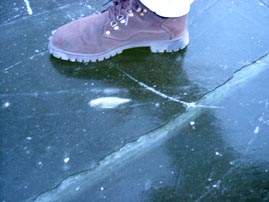
Standing on ice - When is it possible?

Ice covering Grenadier Lake, High Park Toronto. The ice was 8 cm thick, enough to stand on. The small patch in the ice is a dead fish, frozen into the ice. How cold should it be and for how long to have ice thick enough to stand on?

Estimating Stellar Parameters from Energy Equipartition

Many physical systems have a tendency to equilibrate the energy between different subcomponents. Sometimes it is exact, and sometimes not. For example, in an acoustic wave, the wave's energy is on average half kinetic (motion of the gas) and half internal (pressure). In the interstellar medium, there is roughly the same energy in the different components, such as internal energy, turbulent energy, magnetic field and energy of the cosmic rays. Stars are no different. In the sun, there is roughly the same binding energy (which is negative) as there is thermal energy. This can also be shown using the virial theorem. In white dwarfs, the thermal energy is unimportant, instead, there the degenergy energy of the electrons is comparable to the binding energy. We can use this tendency for equipartition to estimate different stellar parameters.

Snow at above freezing temperatures

Did you ever wonder how can it snow at above freezing temperatures? Well, the naive explanation is that it simple takes time for the snowflakes to melt once they penertrate above freezing air, as they descent downwards to the ground. As it turns out, this is the reaons why hail can fall in warm weather. The hail stones simple fall fast, too fast to let the warm air melt the hail.

With snow flakes, this isn't the case. The flakes fall very slowly and the large surface to volume ratio ensure that the flakes can reach thermal equilibrium with the environment on time scales much shorter than their descend time. So, how can the flakes remain frozen as they fall?

Water Propelled Rocket

Water Rockets are simple homemade invensions that model their chemically fueled cousins. Unlike the latter, water rockets operate using water propulsion and hand-pump generated air pressure. Here we describe the equations of the problem. They are also solved numerically in the water rocket calculator.

TeXShop with Unicode Hebrew (i.e., Hebrew Latex on OS X)


Introduction

The best way to obtain a fancy document, with fancy equations, is to use LaTeX (or its cousins). The catch is a high learning curve, but one which is well worth the investment.

If you are working on Mac OS X, this is especially the case, because the standard (mediocre) solution on windoze, which is MS Word, does not exist—Microsoft on purpose avoids adding multilingual support to their Office Suite (why is it that Expolorer is the only browser on the Mac which doesn't support Hebrew?). Other options are no better (NeoOffice, Mellel or Nisus Writer Express) are either costly, don't display equations nicely, or both. (Though NeoOffice, with its 0$ price tag does have very nice advantages, because of which it is worth installation).

Thus, the cheapest (that is free) solution which properly displays Hebrew and math is LaTeX with Hebrew extensions. Since we wish to edit the files on "OS X" and in particular, on the really nice TeXShop front end which supports unicode but none of the other hebrew standards, we require unicode support for LaTeX.

Here is an example: Both the .tex file and the resulting .pdf


Downloading Components

1. Make Sure you install the latest TeXShop and the underlying teTeX engine. This can be done by following the instructions in the TeXShop website. (TeXShop is a front end applications with which you can edit and tex files. The application uses the underlying teTeX engine). It includes TeXShop installation (simple download and copying to the application folder) and installation of different packages using the i-Installer package handler. I used the full 2004 teTeX distribution.

2. Download Ivritex from sourceforge. Uncompress and open the archive. You have two options to install. Either in the teTeX directory (located at: /usr/local/teTeX/share/texmf ) or in your texmf directory in your local library (/Users/<your-login>/Library/texmf). The former option will get erased next time you upgrade teTeX, the latter option will be available only to a single user. To install:
  • cd <the-unachived-ivritex-folder>
  • Install the files required files, by typing:
make TEX_ROOT=/Users/<your-login>/Library/texmf install

For installing it in your Library. You can use the above teTeX/texmf location just as well. If the installation ended with an error, most likely the teTeX installed is not upto date, or, that the teTeX installation was not full.

3. Download unicode support for latex (which supports hebrew, as opposed to the standard unicode which doesn't support hebrew).

  • Unarchive the package. From the ucs folder that will appear, copy the files ucs.sty, utf8x.def, ucsencs.def and data/* to a TeX-path folder. For example:
mkdir /Users/<your-login>/Library/texmf/tex/ucs
cp -r ucs.sty utf8x.def ucsencs.def data /Users/<your-login>/Library/texmf/tex/ucs


Configuring TexShop

Open TeXShop. In the Document pane of the Preferences Window (under the "File" menu), make sure that encoding is set to UTF-8 Unicode. Also, it might not work properly with the TeX and ghostscript option.

You can now edit files. For example, you can use the above example files (here they are again: a .tex file and the resulting .pdf).

Note that in TeXShop, the hebrew is not right justified when you edit the text... but it doesn't change the final appearance of the document which is o.k.

You can also look more deeply at the ivritex examples which you downloaded (they use non-unicode encodings, so you cannot edit them with TeXShop, but they will LaTeX properly!)

The Transit of Venus

Twice every 117 years or so, Venus transits the disk of the sun. Here is some info on the events (and a photograph I took of it).

Row Row Row your Boat - At which maximum speed?

The maximum speed of a rower boat is a classic example of the beauty of dimensional analysis. It was originally derived by McMahon (1971). Here it is brought again for the convenience of the Internet audience, together with updated rowing record data.

Frost Dendrites

Under which conditions can you get frost dendrites on your window?

The Foucault Pendulum

The Foucault Pendulum was conceived by Léon Foucault in the middle of the 19th century, with the goal of proving Earth's rotation through the effect of the Coriolis Force. In essence, the Foucault Pendulum is a Pendulum with a long enough damping rate such that the precession of its plane of oscillations can be observed after typically an hour or more. A whole revolution of the plane of oscillation takes anywhere between a day if it is at the pole, or longer at lower latitudes. Here is a relatively simple derivation of the precession.

Condensation of your exhaled breath

Condensation of Exhaled Breath (the temperature was around 11°C and the RH was about 90%). Note that the water vapor begins to condense only after it mixed with enough outside air, such that it could reach a RH of 100%, when the air cooled to about 32°C.
Ever wondered why and when does your exhaled breath condense? The simple answer is of course that as your breath mixes with the cold outside air, the relative humidity (RH) increases. If it can reach 100%, then breath condensation will commence.

But how can it be calculated? As the air mixes with the outside air, its state can be described using different combinations of three variables that are a function of the amount of "mixing" with the outside air. For example, we can use the air's pressure, temperature and relative humidity. Of course, some choices are wiser than others. Using the pressure, for example, is smart, since the pressure remains constant as the breath mixes with the outside air. Using the RH humidity, is well, not so smart, this is because the relative humidity depends on the temperature, since the saturation pressure of warmer vapor is higher (i.e., a given RH at one temperature implies a different amount of water content as the same RH at a different temperature).

A good choice for working variables are the pressure (p), the water content (g, i.e., how many grams of water per kg of air) and the enthalpy (which is the relevant free energy as described below). We describe these variables using the mixing ratio which is the ratio between the outside air mass to the total mass in the mixture. Thus, as the air is exhaled, its mixing ratio [[f]] is 0, while it reaches 1 when the exhaled air has mixed with a large amount of outside air.

The variables we use are:
  • The pressure [[p]] of the mixed gas, which remains constant. That's easy.
  • If the water content (gr water per kg of air) in the exhaled air is [[g_0]] and the outside air [[g_1]], then the total water content of the mixed gas is [[ g = (1-f) g_0 + f g_1 ]]. This is because the total amount of water remains constant. To calculate [[g]], we use the approximate relations that:
    [[$  g/[gr/kg] = 6.2 10^{-3} p_{w}/[Pa]  $]],
    where the water vapor pressure is:
    [[$  p_{w}/[Pa] = RH \times 610.8 \exp \left( { 17.2694  T_C  \over T_C + 238.3^\circ} \right)  $]].
    Here, [[T_C]] is the temperature in °C.
    Thus, given the temperature and RH, the water content can be calculated.
  • The last variable to use is the enthalpy of the system. Because the mixing takes place under constant pressure, it is the total enthalpy [[H = U + PV]] and not the internal energy [[U]] which is conserved. This can be seen using the first law of Thermodynamics (which is essentially conservation of energy):
    [[$ dH =  dQ -dW + d(PV) = dQ - pdV  + p dV + V dp = dQ + V dp = 0 $]]
    in a process which is both adiabatic [[(dQ=0)]] and under constant pressure [[(dp=0)]]. We use an approximation for the enthalpy, which is:
    [[$  \left{h  \over [kJ/kg]} \approx (1.007 T_C-0.026)+{g\over [gr/kg]} \times (2.501+0.00184 T_C)  $]].
    If the water vapor actually started to condense, we have to consider the fact that the enthalpy of the condensed water is lower by the heat of vaporation. If we separate the water content to the vapor and condensed parts, [[g=g_v+g_c]], we have:
    [[$ \left{h  \over [kJ/kg]} \approx (1.007 T_C-0.026)+{g_v\over [gr/kg]} \times (2.501+0.00184 T_C) + {g_c\over [gr/kg]} \times 0.00419 T_C  $]].
    For a mixture, we have [[h = (1-f) h_0 + f h_1 ]].


Parameters of the exhaled breath: A common misconception is that exhaled air is 100% saturated at 37°C. If this were the case, we would have seen condensation under any condition with outside air colder than 37°C. Obviously this is not the case! The reason is not that the air inside the lungs cannot reach equilibrium with the humid surfaces of the alveoli, in fact, because of the huge total surface area, equilibrium is reach immediately, however, the equilibrium is between the air and the saline solution composing us. Moreover, the saturation vapor pressure above a saline solution is lower than over pure water. (This is because some of the water molecules in the saline solution are bound to the salt ions and therefore cannot evaporate). Thus, air leaving our mouths is only about 35°C and 95% humid.

Using these relations, we can calculate the water content and enthalpy of the exhaled air and outside air, and using the mixture relations, obtain [[g(f)]] and [[h(f)]]. By inverting the relations above, we can thus obtain [[T(f)]] and [[RH(f)]]. If for any mixing ratio, we obtain RH>100%, we necessarily get condensation. The smaller the initial mixing ratio for condensation, the closer to our mouth it begins. Also, larger final mixing ratio correspond to longer durations until the mixed exhaled air dilutes enough for the condensation to evaporate again. Moreover, higher maximum condensed water content implies a thicker condensation.

Exhaled Condensation Calculator
Using the above equations, we can calculate whether the exhaled air will condense. Enter the conditions of the outside air (and modify the exhaled air parameters if you wish), to see whether your breath will condense, or not.

Exhaled Air:    
RH
°C
Outside Air:    
RH
°C


Powered by Drupal