general physics

Characteristics of an LC circuit using Equipartition

An LC circuit is one which has a capacitor and an inductor connected to each other. It exhibits oscillations just like a mass on a spring (a harmonic oscillator). In fact, the analogy is quite accurate with the capacitor playing the role of the spring and the inductor playing the role of the mass inertia.

Just like any harmonic oscillator, we can use equipartition to estimate the energy and frequency of oscillations using equipartition.

The average energy in the capacitor is:

ContentType:

Estimating the Size of the Hydrogen Atom (i.e., Bohr's Radius) using Equipartition

The standard way to obtain the size of the hydrogen atom, also known as Bohr's radius, is to solve Schrödinger equation for the hydrogen atom. This is a somewhat detailed calculation requiring the usage of generalized Laguerre polynomials and spherical harmonics. We can however bypass it, if we are only interested in an estimate of the hydrogen atom.

One method which we don't follow here, is to estimate the size of the atom using dimensional analysis. Instead, we shall do so using the principle of equipartition.

ContentType:

Why don't I believe the that neutrinos travel faster than the speed of light?

Three weeks ago I visited the underground laboratory of Gran Sasso near l'Aquila. Little did I know that it would make headline news so soon, for "discovering" particles moving faster than the speed of light. Since a few people asked me what did I think of it, I decided to write something about it here.

Type:

From Masada to the Messinian Salinity Crisis

Masada, the Dead Sea, the Messinian Salinity Crisis and Augustus Ceasar, all in one post.

A visit to Stromboli

Last May I had a conference in the island of Vulcano. During the conference I had a half day excursion to the Island of Stromboli, where I climbed the mountain and got to see one of the most impressive geological phenomena one can see... Here are my impressions, photos and even a movie of it.

Type:

Bush in a quantum entangled state

On my personal views of President Bush's visit to my humble town of Jerusalem. A few thoughts about quantum mechanics and the speed of sound.

Type:

Corpuscular Rays in St. Peter's Basilica (the Vatican)

A few days ago, I stayed in the Vatican (more about this one day symposium in another post). During the stay, I naturally visited St. Peter's Basilica. Near Bernini's Altar, I saw corpuscular rays. It may seem like some godly thing (quite appropriate for the location), but from a physicists point of view, it is simply scattering by dust particles. Here is one can say about this holy dust with the help of a little envelope.

Type:

blog topic:

A Nice Black Hole Merger Simulation

I recently stumbled upon a nice black hole merger simulation.
Since it is not in my habit of just regurgitating stuff I see on the internet, here is my added value. How can one estimate the quadrupole gravitational radiation of a binary? How close does the binary have to be for it to coalesce within the age of the universe?

Type:

Parhelic Circles, Ice Haloes and Sun dogs over Jerusalem

A few weeks ago, a few students saw a nice phenomenon in the sky. Knowing I liked this kind of stuff (and that I may be able to explain it), they called me out of the office to look at the sky. Above us was a nice and almost complete parhelic circle. Unlike the usual 22° halo, often seen around the moon and occasionally around the sun, the parhelic circle keeps a fixed angle from the horizon, not from the bright object.

Type:

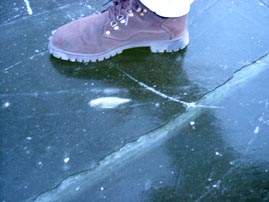
Standing on ice - When is it possible?

Ice covering Grenadier Lake, High Park Toronto. The ice was 8 cm thick, enough to stand on. The small patch in the ice is a dead fish, frozen into the ice. How cold should it be and for how long to have ice thick enough to stand on?

ContentType:

Estimating Stellar Parameters from Energy Equipartition

Many physical systems have a tendency to equilibrate the energy between different subcomponents. Sometimes it is exact, and sometimes not. For example, in an acoustic wave, the wave's energy is on average half kinetic (motion of the gas) and half internal (pressure). In the interstellar medium, there is roughly the same energy in the different components, such as internal energy, turbulent energy, magnetic field and energy of the cosmic rays. Stars are no different. In the sun, there is roughly the same binding energy (which is negative) as there is thermal energy. This can also be shown using the virial theorem. In white dwarfs, the thermal energy is unimportant, instead, there the degenergy energy of the electrons is comparable to the binding energy. We can use this tendency for equipartition to estimate different stellar parameters.

ContentType:

Have you heard of the silent Earthquake?

Did you know that there are huge earthquakes which aren't felt? Did you know that similar waves appear everyday when two objects with dry friction between them start to move?

Type:

blog topic:

Exhale Condensation Calculator

If the temperature is low enough or the humidity high, you can observe condensation (i.e., "fog") forming in your exhaled breath. This calculator estimates whether your exhaled breath will condense, and if so, the range of mixing ratios for which the "fog" will form and the maximum condensed water content (the higher it is, the "thicker" the condensation).

If you're interested, there is a much more detailed explanations of the condensation process.

Exhaled Condensation Calculator
Using the above equations, we can calculate whether the exhaled air will condense. Enter the conditions of the outside air (and modify the exhaled air parameters if you wish), to see whether your breath will condense, or not.

Snow probability calculator

Based on the analysis of whether falling snow will melt as it descends, it is possible to estimate the probability with which falling precipitation will be snow.

ContentType:

Snow at above freezing temperatures

Did you ever wonder how can it snow at above freezing temperatures? Well, the naive explanation is that it simple takes time for the snowflakes to melt once they penertrate above freezing air, as they descent downwards to the ground. As it turns out, this is the reaons why hail can fall in warm weather. The hail stones simple fall fast, too fast to let the warm air melt the hail.

With snow flakes, this isn't the case. The flakes fall very slowly and the large surface to volume ratio ensure that the flakes can reach thermal equilibrium with the environment on time scales much shorter than their descend time. So, how can the flakes remain frozen as they fall?

ContentType:

Pages

Subscribe to RSS - general physics